

This is a practical article for those who want to make sure to improve "the sound of rain echoing" and "the hot summer attic" as much as possible, even in DIY.
Introduction: Why metal roofs are "noisy and hot" (minimum logic)
When raindrops hit a thin metal plate, the plate vibrates, and the vibrations are radiated into the air as sound. The sound insulation of a veneer generally follows the "mass law", and the higher the areal density (weight) and the higher the frequency, the higher the transmission loss (the basics are laid out in the technical data of the Japan Acoustic Materials Association). Furthermore, there is also the ``coincidence effect,'' which reduces sound insulation at frequencies where the speed of sound matches the unique bending waves of the board. Therefore, the combination of ``increasing mass'', ``dampening vibrations to suppress noise'', and ``creating multiple layers to create air layers and ventilation'' will be effective.
In terms of perception, there is a known guideline for listening, such as "whispering → half of the sound pressure level when it drops about 10dB" (relationship between the Thorn scale around 1kHz). It can be used as an indicator for comparing options.
How to use this page (quickly how to decide)
- "Be quiet on the outside" or "take on the inside."
- Confirmed restrictions on weight, budget, and fitment (screw length, and height).
- Balance the expected effects (dB guideline, summer heat) with construction period and difficulty.
- Follow the basic rules for rain shutdowns, ventilation and ventilation (the standard roof ventilation layer is 30mm or more).
List of options (features, orientation and not suitable)
Option A: Recover with an integrated metal roof material (e.g. Super Gartect, horizontal roof)
The roofing material, which is integrated into a factory with steel sheets and hard insulation foam, is the insulation that accepts the "rhythm" of the boards, greatly reducing the sound of rain. In the manufacturer's experiments, the idea was that "even in heavy rain, the room is only a whisper" (effect of integrated insulation molding).
The person who is looking for it: "I want to update the roofing material itself and get all the quiet and insulation all at once," and "I want to revamp the exterior."
People who are not suitable: ``I want to keep the existing sheet metal,'' ``I want to get it done with minimal construction.'' Since it is made of composite materials, the cost of dismantling it will be very expensive, so you want to avoid it.
Expected Products:
- IG Kogyo's "Super Gartect (IG roof)" type (compatible with heat insulation, with explanations of sound and heat insulation).
- Nichiha "Horizontal Roof" type (integrated with hard urethane foam reduces rain noise and has written statements that it has passed the spread-flame performance test).
Option B: Replace with metal roof with stone chips (natural stone chips)
This type is a type that allows natural stone particles on the surface to diffuse raindrops and reduce resonance, achieving a quiet, even though it is a metal roof. Articles from leaflets and construction stores in various companies mention "diffusion and absorption of rain sounds."
Expected Products:
・"Diplomat Star" and "Dies Roofing" etc.
The person who is suited to the person is "The appearance is the texture of stone grains" and "Covered with weather, heat insulation, and quietness in the package."
Note: It is slightly more heavy than regular steel sheets (although it is much lighter than tiles).
In which country is "Diplomat Star" used?
1. America (from California)
- "Diplomat Star" isManufactured by Dee Trading Inc. in California, USAIt has been imported and sold in Japan under the "D's Roofing" brand since 1998.
- It has already been over 40 years since its production began.Employed in more than 70 countries around the worldWe have a track record of doing so.
2. All over the world (Europe and America, Northern Europe, Southeast Asia, Oceania, Africa)
- Metal roofing materials with stone grains are not only available in Europe and the United States.Nordic, Southeast Asia, Africa, OceaniaIt is also mentioned that it is being used.wealthcheer.com+5yokohama-yane.com+5arise1.jp+5
3. Other brands and international manufacturers
- The stone tip metal roof, which originated in the UK, was developed after the war, and is manufactured and sold by AHI Roofing, a New Zealand (now RoofTG), in more than 80 countries around the world. Famous brands include "Decra", "Gerrard", and "ROOFKO".
- In other words, even though it is not familiar to Japan,Technologies and methods that are widely used worldwide.
Option C: Place a wooden board (such as a billboard) on top of the field
Lay a "wood fiber board" on top of the ground plywood, then roof it, ventilate it, then metal roof. The addition of the board's mass and internal friction (vibration control) relieve high-pitched squeals, while the wood-like thermal resistance also blows the heat in the summer. Daiken Kogyo's Billboard is clearly stated for use as a roof underlayer, with a thickness of 9mm/12mm, and manufacturers say that 12mm is better for sound insulation and insulation (Specifications and Features page).
Suitable for: ``I plan to replace the existing sheet metal, but I would like to improve the quietness and insulation of the base.''
Note: The weight will increase slightly. Due to the thickness, it is necessary to confirm the fitting of the screw length and the height of the handle.
"Affiliate Insertion Point": Billboard 9mm/12mm/Compatible Screws/Heat-shielding roofing.
Option D: Vibration-control tape/sheet is attached to the back of the metal plate (partially pasted)
A fastball strategy to stop the "rance" of the board itself. There is a product in the technical document that shows that it "reduces rain noise by 10dB" by applying approximately 30% to the width of the roof material's function (published PDF of Zetro NV-α II).
There is also a similar polyolefin anti-vibration sheet (bibless roof sheet), which suggests durability and ease of installation, assuming that it will be attached to the back of the roof sheath.
The person facing the event is "I want to use my current roofing materials while putting my hands on it," and "Minimize the increase in weight and thickness."
Note: The price per area is likely to be slightly higher/it's a hassle to stick.
Option E: Finish on the indoor side (sound absorption/insulation/addition of mass)
Anything that cannot be removed by the outer skin is then supported by rock wool filling inside the interior, thorough airflow prevention, double ceiling plasterboard, and anti-vibration hanging. In the basics of acoustics, "heavy, multi-layered, no gaps" is the golden rule for sound insulation, and sound-absorbing materials are effective in reducing reverberation inside the room (see basic materials).
Those who are suited to the office: "Minimize outdoor work," "Want to keep budgets down," and "Preparing for ceiling renovations at the same time."
Note: The sound of rain on the roof itself is reduced, but the effect is slightly limited than the measures against the outer skin.
Which one should I choose? (Recommended combinations for different purposes and constraints)
- "I want to make a big difference in my experience in the shortest time."
→ Choice A (Insulated Roofing Material) or B (with stone grains) + Choice G (Optimization of ventilation and ventilation).
Essential: Integrated insulation and surface stones diffuse and absorb rain sounds. A manufacturer's experiment showed "just a whisper." - "The existing roof shape remains the same; priority is given to fitting."
→ Choice C (Billboard) + Roofing + G (Breathable)
Base: Mass, vibration control and thermal resistance are added to the roof base, and the roofing contributes to primary waterproofing and sound insulation. - "There is no room for weight and screw length."
→ Option D (Vibration-damping tape band: 30% working width) + G (breathing)
Evidence: Materials that reduce 10dB using 0.55mm vibration-damping tape. - "I want to complete it indoors"
→ Option F (ceiling side) + G (review of attic ventilation)
Common rules to be sure to hold: ventilation, ventilation, fire prevention
The public design and construction text clearly states that the roof vent layer is "30mm or more standard" (a vent layer must be installed on the outside of the insulation layer). When it comes to attic ventilation, failures will be reduced by following the "guidelines for effective opening area" for each type, such as intake and eaves (see 1/900 for wing exhaust and eaves).
In semi-fireproof areas and 22-Article area of the Act, it is also important to check the certification and compliance of roofing materials and ventilation components (such as information on passing the spread-out performance test for horizontal roofs).
Construction practice: How to play the “material level” steps and quantities for each construction method
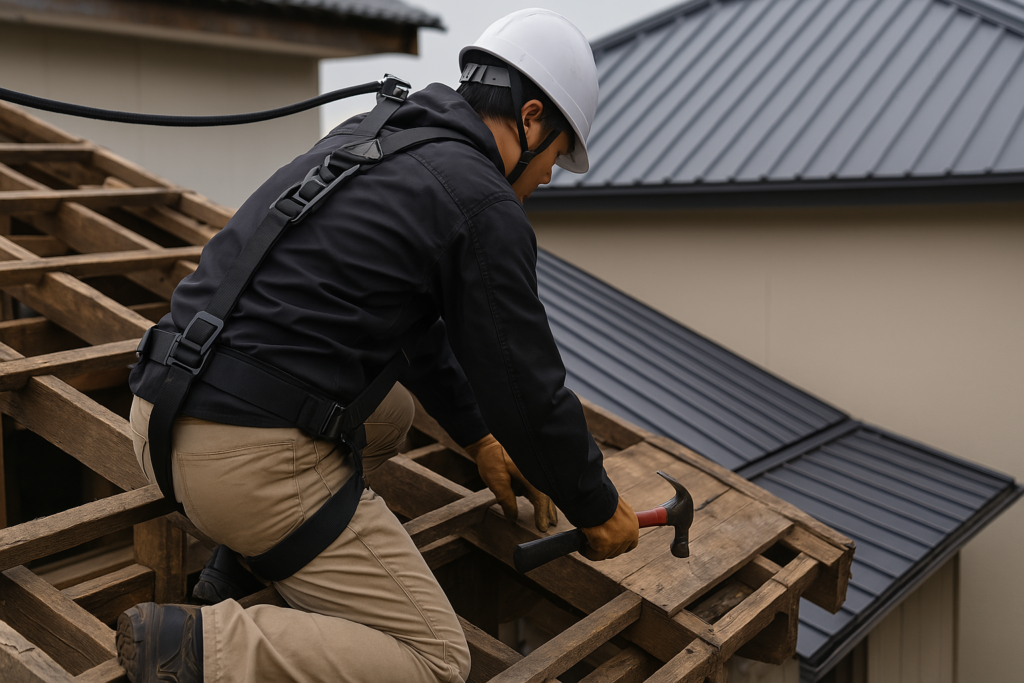
Below is the standard flow assuming DIY. First ensure safety (full harness, main rope) and weather (continuous installation until the roofing is complete).
Construction Method A: Reroofing with metal roof material that is integrated with heat insulation (Super Gartect, horizontal roof, etc.)
- Preliminary investigation
Actual measurements of "roof area A," "flow length L," "eave length W," and "roof slope." Check for the presence of existing field grounds, flexion, and rain stains. - Removal (replacement)
The removal order is "Keraba → Build wrap → Arabesque → Body → Valley." Nails and screws are collected in a magnetic tray. Clean after exposed to the base. - Repairing the base
The rotten plywood is replaced by cutting and screws to make it work on the joists and rafters. Adjust the unevenness with putty or thin veneer. - Thatched roof (roofing)
"Take the eaves to the top → go up." The tapered width, rise, double valley, nail hole seal, and penetration part are tapered according to specifications. - Benefits attached
Arabesque, valley tips, and the end of each part. Follow the order of the manufacturer's installation diagram. - Body hanging
The integrated insulation panel is secured with screw clips with a specified pitch. Working length, stacking allowance, and edge treatment are carried out as specified. - Building/Keraba Closed
In the case of fittings that work in conjunction with the ventilation building, continuous openings are ensured in the building. Don't forget to use the doors and insect-proofing parts.
How to play quantities:
・Number of roofing materials = area ÷ work area per sheet (estimated loss 10%)
・Screw length = Selected by total of "body edge + base + effective depth"
・Accessory parts = Calculated based on building length, burial height, and valley length
→ See the "Quick reference table of required number of items" for each product (manufacturer's website).
"Insertion Point": EC links (Rakuten, Yahoo, Amazon) for each model of the target roofing material.
Construction Method B: Renewal to a metal roof with stone grains
The steps are almost the same as method A. The difference is that the roofing material requires interlocking, special nails, and adhesives.
- Tanibe has selected special items that suit pre-installed, eaves starters and arabesques.
- Be careful to keep the thickness of the stone grain layer in the building and crenata.
For the basis for the effect (diffusion and heat insulation), please refer to the references in each company's documents.
"Insert Point": Diplomat Star, Dee's Roofing product page and quote form.
Construction Method C: Place a billboard (wooden board) on top of the field
- Temporary storage plan
``Clearance of 10 to 12 mm on all sides'' and ``shifted joints like brickwork''. Do not match the seams of the field with the joints. - Fill in
Fasten with nails/screws at the specified pitch while leaving the street out from the end. Follow any instructions such as the direction of the printed surface. - Under roof (heat-shielding roofing recommended)
First-hand → genuine-handed. The double valley, overlapping width, rising and penetration seals are as specified. The roofing is the main focus for primary waterproofing. - Ventilation layer formation
Continuously extending vertical body edges of 18 to 30 mm or more from the eaves to the building. Openings are ensured in the building, and ventilating materials are connected to the ventilation building, with insect-proof mesh at the eaves. - Metal roof body
The clips and slats are positioned to match the specifications of the ridge and horizontal roofing.
How to play quantities:
・Number of billboards = A (roof area) ÷ 1 sheet area (910 x 1820 = 1.657 m2) x (loss 10%)
・Weight difference: Approximately 2 kg/㎡ difference between 9mm and 12mm (as a guide, see product specifications for details)
・Ventilation body edge = number of rows (roof width ÷ pitch) x flow length
→ Check the official page for product specifications and cautions.
"Insert Points": Billboard 9mm/12mm, heat-shielding roofing, roof course threads, ventilation ventilators and eaves.
Construction Method D: Vibration-damping tape/vibration-proof sheet with obi attached
- Dimension planning
The number of pieces is calculated based on the "working width W" of the roof material, tape width w, and application rate r (approximately 0.3).
Examples: W=333mm, w=65mm, r=0.3 → n≈(0.3×333)/65 ≈1.54 → Designed with "two belts". - Preparation
Degrease and dry the back side with alcohol, etc. If the temperature is low, store at room temperature. - Paste
Ink out → Squeeze with a pressure roller while removing air bubbles. The edges are beveled to prevent peeling. - Interference confirmation
Make a notch and escape to prevent interference with the clip screw position, valleys, ridges, and crenas. - Inspection
Re-crimp the flipping and floating of the device. Follow up if necessary.
How to play quantities:
Total extension = (number of strips per piece n) x (flow length L) x (number of roofing materials N). Divide it to the number of 20m rolls.
Estimate of the effect: Technical document (Zetro NV-α II) that reduces rain noise by 10dB with a working width of 30%.
Similar: Sekisui Chemical "Vibress Roof Sheet" (vibration-proof sheet for roofs, effective when applied partially).
"Insertion Point": Tape (45/65/100mm), crimp roller, degreaser.
Construction Method E: Quiet sound on the indoor side (sound absorption, sound insulation, airtightness)
- Attic inspection
Check for missing insulation, gaps, and lack of air flow prevention, and add the required amount of rock wool. Install an airflow stopper. - Substrate
If necessary, assemble the ceiling underlay using vibration-resistant hanging wood. - Finishing
Double plasterboard (12.5mm x 2) + joint seals increase the area density, and caulk makes it airtight.
The downlight is airtight and the inspection port has also been replaced with a gasket.
For the logic of sound (the basis of mass rules), please refer to the above document.
"Insertion point": Rock wool, high specific gravity PB, anti-vibration hardware, airtight material.
Practical ventilation and ventilation (don't get confused about the numbers)

-Roof ventilation layer = "30mm or more is standard." There is always a ventilation outside the insulation layer, so there is no need to stop from the entrance (eaves) to the exit (building).
- Attic ventilation = Follow the guidelines for effective opening area for each type. For example, if it is a "intake and vent exhaust" configuration, it is possible to organize more than 1/900 intake and more than 1/1600 exhaust (Joto Techno's technical page). There is also a tool that allows you to calculate the number of items based on the product's "effective ventilation area (cm²/piece)."
"Insertion Points": Ventilation building, eaves ventilation materials, insect-proofing finish.
Specific example: Approximate quantity for standard one-sided flow/vertical (working width 333 mm)/roof area 70 m2
Assumption: Flow length 5.0m, eave length 10.0m.
・Vibration control tape (Construction method D)
r=0.30, w=65mm → Number of strips per piece≈2.
Number of roofing materials N = eaves length 10.0m ÷ 0.333m ≈30 rows.
Total extension ≈ 2 pieces x 5m x 30 rows = 300m → 20m rolls x 15 rolls.
・Billboard (Construction Method C)
Number of sheets required ≈ 70㎡ ÷ 1.657㎡/sheet ≈ 43 sheets → Approximately 48 sheets including scrap material loss.
・Ventilated body edge
If the pitch is equivalent to 303mm, the number of rows is ≈ 10.0m ÷0.303 ≈ 33 rows, 5m in length per row → Approximately 165m + edge part.
・Roofing
Looking at the overlapping, edges, and double valley, it is converted to a roll by about 1.2 times the area.
Common pitfalls (must avoid)
・"The roofing was cut off midway, and the surface that was drained from the rain was divided."
→ The roofing is primary waterproof. The overlap direction, width, and double valley are as specified.
・"Ventilation gets clogged in the middle"
→ Do not create dams with the body edge or horizontal bar (notches and slits). Continuously from the eaves to the building.
・"Vibration-proof tape is stuck on the spot"
→ Banding (approximately 30%) is effective against the working width. Use a pressure roller to round off the edges to prevent peeling.
・"Soundproofing sheets (indoor MLVs, etc.) are reused on the roof"
→ There are many cases where performance is not guaranteed due to high temperatures and humidity on roofs. Choose the materials specified for roofing.
Summary: Recommended presets from the editorial department (If you're unsure, here's it)
How was the article?
・"Lightness, fit, and cost balance"
→ Construction Method C (9mm Billboard) + Construction Method D (30% vibration-damping tape) + Construction Method G (30mm ventilation, exhaust airflow) + Heat-shielding roofing.
Essence: By combining the mass of the base and vibration control of the plate, it effectively removes high-pitched cannes.
・"I want to change my experience to the maximum"
→ Construction Method A (Super Gartect/Horizontal Roof) or Construction Method B (with stone grains) + Construction Method G.
Essence: The presentation of experiments and materials equivalent to "whispering" and the mechanism of diffusion and absorption by stone particles.
・"Do not peel off the roof and use the minimum amount of effort"
→ Method D (damping tape) + Method G.
Evidence: The material is clear and reduced by 10dB with a 30% working width.
With any plan, if you consider the final set of "reviewing ventilation and ventilation (roof ventilation layer of 30mm or more, opening area for attic ventilation), you can feel at ease in terms of both summer heat and the risk of condensation.
If you're wondering "How much renovation or remodeling can I actually do on my own home?" or "Where should I even start?", please visit this page. If you're looking to learn more about specific renovation processes or construction details, don't miss this page as well!
Appendix: Safety and Regulations (minimum even for DIY)
- When working at high altitudes, we thoroughly ensure double-layered use of a full harness-type fall prevention device and a main rope.
- In semi-fire prevention areas and Article 22 of the Act, certification of the roofing materials and ventilation components used has been confirmed (the horizontal roof has a notice that it will pass the spread-out performance test).
*Based on the reference links of this article, please be sure to check the latest catalog for discrepancies and specifications in the product name.
References and evidence links (main primary information and technical materials mentioned in the text)
・IG Kogyo: "Metal roof material, IG roof: Sound insulation performance (with integrated insulation material, showing just a whisper of rain sounds)"
・Nichiha “Yokowara Roof: Integrated molding of rigid urethane foam reduces rain noise / Passes spark flying performance test”
・Daiken Kogyo “Billboard: Used for roof base, rain noise reduction/insulation effect, specifications (9mm/12mm)”
・Iida Sangyo: "Zero Metal Roof Vibration Control Tape, Zero NV-α II: 30% working width to reduce rain noise by 10dB (technical document PDF)"
・Sekisui Chemical: "Bibless Roof Sheet: Anti-vibration sheet for roofs, partially pasted to reduce rain and impact sounds."
・Ube Building Materials: "Waterproof sheet for roof underneath: "Waterproof soundproof sheet" system (in catalog)"
・Ministry of Land, Infrastructure, Transport and Tourism Text: "Home Energy Saving Design and Construction 2023: Roof Ventilation Layer 30mm or more"
・Joto Techno: "Standards and concepts for attic ventilation calculations: Estimated effective opening area"
・Ono Souuki Technical Report: "Sound Volume (Thorn): 10dB, about twice as much experience" and "Fundamentals of Sound Pressure and dB"
・Explanation of sound and heat insulation for metal roofs with stone grains (Diplomat Star Dee's roofing) (Explanation articles for multiple construction shops)
 English
  Japanese
Leave a Reply
You must be logged in to post a comment.