
Hello everyone, this is DIY Renova.
If you've been doing DIY for a long time, you tend to think that tools and protective equipment are something you buy once and will last a lifetime, but in reality, there are many items that require regular maintenance and replacement. In this article, for those who are self-renovating in Japan, we will summarize ``which items'', ``how often'', and ``how to check and replace''.
If you're wondering "How much renovation or remodeling can I actually do on my own home?" or "Where should I even start?", please visit this page. If you're looking to learn more about specific renovation processes or construction details, don't miss this page as well!
Here you go.
Ideas for regularly replacing items that you should know if you are doing DIY
First of all, it is essential to periodically review ``things related to safety'' and ``things related to hygiene and comfort.''
Especially when it comes to self-renovation,
- working at heights
- Work that involves a lot of dust and dust
- Work with knives and power tools
becomes routine. In Japan, the majority of industrial accidents are physical accidents such as being caught, cut, fallen, or hit, and the presence and condition of protective equipment is said to affect the severity of the damage (according to the Ministry of Health, Labor and Welfare's labor accident statistics, etc.)Ministry of Health, Labor and Welfare.
The key is not to think ``I'm fine because I'm wearing a helmet,'' but also ``How long have you been using that helmet?''
Things you want to replace in the short term: Work gloves/work gloves
Why work gloves and work gloves are short-lived
It is safer to treat work gloves and thin work gloves as "consumables."
The reason is simple;
- Abrasion and holes
- Becomes slippery due to dirt or oil
- Inhaled chemicals and dirt can cause skin problems
Because there are risks.
Surveys at industrial sites have also shown that protective gloves that protect the skin from chemical substances should be selected and replaced by taking into account the "penetration time" (how long it takes for the substance to penetrate) and "deterioration".J-STAGE. Even at the DIY level, the same idea is required when dealing with paints, thinners, cleaning agents, etc.
How often should it be replaced?
To answer the question, "How many times should you use work gloves before throwing them away?", there is no exact number of times, but we recommend the following as a guideline.
- Work that involves heavy wear such as "wood chips, plasterboard, insulation materials, etc.":
→ If you notice any fuzzing, holes, or thinning within a day or a few days, replace it immediately. - "Light work (cleaning, carrying luggage, etc.)":
→ OK to wash and use several times. However, if it becomes frayed, thinned, or slippery, replace it. - "Gloves for handling paint, thinner, and adhesives":
→ Once used, do not reuse them (volatile organic solvents will soak into cloth gloves)
Especially when handling chemical substances, ``using dirty work gloves even the next day'' itself can cause skin problems (The Ministry of Health, Labor and Welfare's protective equipment selection manual also points out the importance of replacing and maintaining chemical protective gloves.)Ministry of Health, Labor and Welfare.
How to choose work gloves and gloves recommended for beginner DIYers
It's useful to have several types of gloves for different purposes, not just work gloves.
- “Normal cotton work gloves”: For wood, light loads, and simple cleaning
- "Non-slip work gloves": Convenient when transporting large planks such as plasterboard and two-by-one materials
- "Synthetic rubber (nitrile) coated gloves": For detailed work, screw driving, and tool work
- "Blade-proof gloves": Reduce risks when handling circular saws and cutters (but not "absolutely safe")
Items that need to be replaced in the long term: Helmet lifespan and checkpoints

Helmets also have an expiry date.
If you are doing DIY work such as climbing on scaffolding, using a stepladder, or doing any work where objects may fall from high places, a "hard hat (construction helmet)" is a must.
Another thing that many people tend to overlook is the "lifespan of the helmet." The standards of the Japan Helmet Industry Association provide guidelines for disposal and replacement for each material.midori-helmet.jp.
- Made of ABS/PC/PE (thermoplastic resin): Replace within 3 years of use even if there is no abnormality in appearance.
- Made of FRP (thermosetting resin): Replace within 5 years even if there is no abnormality in appearance.
- Inner hammock (attached body): Replaced within 1 year even if there is no abnormality
In addition, it is recommended that helmets that have been subjected to even one major impact should not be reused, even if they appear to be intact.japan-helmet.com.
A common DIY project is to simply use an old helmet that you received at a friend's construction site or a used helmet you bought on Mercari, but this is quite risky as you don't know how old it is or it may have already expired.
Points to check before using for the first time in a while
If you've been taking a break from DIY for a while and it's been a while since you pulled out a helmet, check the following points.
- Is the "manufacturing date" and "starting date of use" written on the label?
- on the shell (hard outer part)
- cracks
- Discoloration (extreme yellowing, whitening)
- sticky
Is there something missing?
- On the attached body (inner band cushion)
- crack, cut, stretch
- Accumulation of sweat and dirt
Is there something missing?
Japanese safety standards also point out that deteriorated helmets have reduced shock absorption performance and may not be able to adequately protect the head in the event of an accident.midori-helmet.jp.
An inexpensive JIS-compliant helmet that you recently purchased is often safer than a helmet that looks okay but is from 5 years ago.
Summary of helmet replacement timing
To summarize from a self-renovation DIY perspective, we recommend the following operations.
- If you are working on roofs, exterior walls, or scaffolding, prepare a helmet specifically designed for DIY.
- Write the start date on masking tape and stick it on the inside of the helmet.
- If it's been over 3 years, "don't hesitate to replace it"
- If you receive a strong impact, replace it immediately regardless of age.
- The inner band pad should be replaced every 1 to 2 years, assuming it gets covered in sweat.
Things to review in the medium term: Masks and filters
Dust masks and filters are also ``not disposable, but not forever.''
Cutting plasterboard, scraping mortar, sanding wood—these DIY tasks generate a lot of fine dust.
Inhaling dust can put a strain on the airways and lungs in the long term (occupational pneumoconiosis is a typical example), so the use of dust masks and filters is recommended. The Japanese manufacturer's explanation also recommends that ``If you feel that it is difficult to breathe due to clogging, replace the dust filter.''koken-ltd.co.jp.
Practical guidelines for filter replacement
If you are using it at a DIY level, it is easy to understand if you operate it as follows.
- "Simple disposable mask"
→ Discard after each day's work. In particular, do not reuse plasterboard, mortar, insulation materials, etc. if they have powder on them. - "Replaceable dust mask filter"
→ If you feel "suffocation" due to clogging, replace it immediately (this standard is also indicated in the manufacturer's commentary)koken-ltd.co.jp
→ Even if you don't have difficulty breathing, it's a good idea to change your clothes on the day you were exposed to a large amount of dust. - "Absorption cans for organic gases (paints, thinners, etc.)"
→ If you start to notice a smell, it is a sign that the adsorption performance has already deteriorated, so replace it immediately.
→ The Japanese manufacturer's FAQ also recommends replacement based on usage time management and weight increase.sts-japan.com
When it comes to DIY, the worst cost performance is to continue using the filter sparingly and injuring your body, so it's best to avoid the ``mottainai mentality'' here.
Other items you should be conscious of regular maintenance/replacement
Goggles/safety glasses
- If the lens becomes scratched, cloudy, or the coating deteriorates, visibility will worsen and it can be dangerous.
- If you work with flying dust or sparks, we recommend checking the lens surface regularly for scratches and replacing it when you feel that your vision is not clear.
The Japan Safety Eyewear Industry Association and other organizations emphasize the importance of selecting safety glasses for each purpose.Ministry of Health, Labor and Welfare.
As an affiliate,
- "Goggle type that can be worn over glasses"
- "Safety glasses with anti-fog coating"
It would be helpful to introduce types that are close to the concerns of actual DIY users, such as.
Earmuffs/earplugs
- Using tools such as circular saws, disc grinders, and impact drivers for long periods of time can put a significant strain on your hearing.
- Ideally, earmuffs and earplugs should be replaced when they become worn out and become difficult to fit properly, or when the sponge collapses.
Hearing protectors should originally be selected based on the noise level, but when doing DIY renovations, it is more realistic to start by wearing something to protect your ears.
Knee pads, waist belts, harnesses, etc.
- Self-renovation projects that involve a lot of floor work often involve kneeling for long periods of time and lifting heavy objects.
- If the cushioning material is crushed or the rubber band is stretched, the purpose of a knee pad will be diminished, so it is a good idea to review the condition every six months to a year.
- For those who work on scaffolding or at heights, full harnesses need to be replaced regularly every 3 years after first use, and lanyards need to be replaced every 2 years after first using them!
When it comes to equipment to protect your body, it is ultimately cheaper to replace it preventively when it wears out, rather than replacing it after it breaks.
It will be easier if you create your own “replacement cycle chart”.
Manage with calendar or notebook
If you have been doing self-renovation for over a year,
- "When did you buy this helmet?"
- "How many times have you used the filter?"
This tends to happen. What I recommend is to create a rough exchange cycle table.
For example, the following image.
- Helmet body: Start date of use/Scheduled replacement date (3 years later)
- Interior/Hammock: Start date of use/Scheduled replacement date (1 year later)
- Dust mask filter: Make a note of the replacement date each time (or write it on the case with a marker)
- Earmuffs/earplugs: Schedule a “condition check” date every six months to a year
- Work gloves/thin gloves: Buy in bulk and use a cycle of ``replenishing when you run low.''
If you put schedules such as ``helmet update'' or ``interior replacement'' on your smartphone's calendar, you won't forget them.
As a blog, it would be a good idea to prepare a ``simple exchange check sheet for download'' or a ``Notion template'' here and link it with other articles or e-mail newsletters.
Balance between Japanese local rules and global perspective
In overseas DIY culture, there are cases where people don't even wear a helmet or just wear goggles and earplugs, but in Japan,
- Scaffolding work
- Highway work
- Sites where power tools are used
, the concept of safety equipment is strongly influenced by the Occupational Safety and Health Act and related regulations.
Although self-renovators are "individuals" rather than "workers," in the sense of "working safely in Japan," it is safer to adopt protective equipment that is in line with Japanese standards and guidelines as much as possible.
For global readers, I think it would be easier to understand the difference if you provided supplementary explanations on the English page, such as ``In Japan, it is clearly recommended that helmets have expiration dates,'' and ``There is a strong emphasis on replacing dust masks and filters to prevent dust.''
Summary: It’s easier to continue DIY if you treat safety equipment as “consumables”
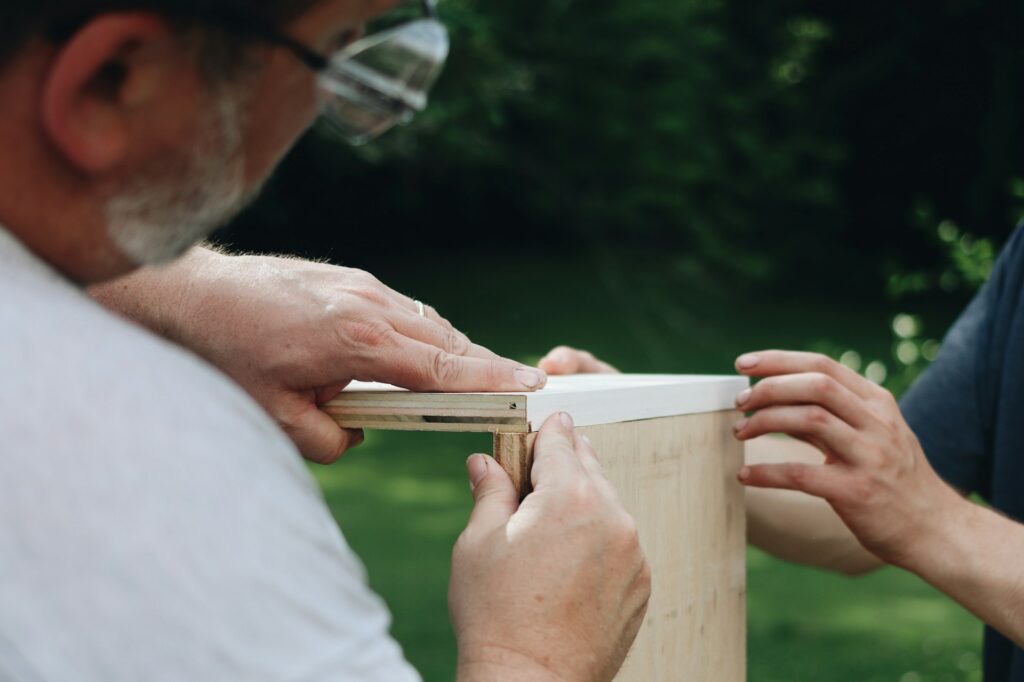
When doing self-renovation, you tend to focus on the cost of materials and tools, but safety equipment and its maintenance and replacement are like an ``invisible infrastructure'' that allows you to continue doing DIY for a long time.
Finally, to summarize the points,
- Work gloves and thin gloves are "consumable items". If you notice dirt, tear, or thinness, don't hesitate to replace it.
- Helmets have an expiration date, with ABS helmets having an expiry date of 3 years and FRP helmets having an expiration date of 5 years (according to the standards of the Japan Helmet Industry Association).midori-helmet.jp
- If you feel ``suffocation'' or ``smell,'' replace your dust mask or absorption canister immediately. Don't skimp on filters on days when you are exposed to large amounts of dust.koken-ltd.co.jp
- Goggles, earmuffs, knee pads, etc. should be replaced when they wear out. When it comes to equipment that protects your body, preventive updates are the most cost-effective.
- By visualizing the "replacement cycle" with a calendar or memo, management becomes much easier.
There is no contradiction between ``using tools with care and using them for a long time'' and ``updating safety equipment in a planned manner.''
In fact, I think it's more important to take the stance of ``thanking things and replacing them when they reach the end of their lifespan'' rather than ``using them until they break'' in order to enjoy a self-renovated life for a long time.
If you're wondering "How much renovation or remodeling can I actually do on my own home?" or "Where should I even start?", please visit this page. If you're looking to learn more about specific renovation processes or construction details, don't miss this page as well!
Information on updates to this website will be delivered to you once a month.NewsletterIf you are interested, please register.
Well then.
References/reference sites
- Japan Helmet Industry Association “Guidelines for replacing bicycle helmets” FAQ etc. japan-helmet.com
- Midori Anzen “Durable life of hard hats”midori-helmet.jp
- Ministry of Health, Labor and Welfare “Selection Manual for Protective Equipment to Prevent Skin Disorders”Ministry of Health, Labor and Welfare
- Isamu Kabe et al. “Survey on the Selection and Wearing of Chemical Protective Gloves in the Workplace” Journal of Industrial HygieneJ-STAGE
- Koken Co., Ltd. “Use and maintenance of masks: Appropriate filter replacement”koken-ltd.co.jp
- Shigematsu Seisakusho Co., Ltd. “Frequently Asked Questions Q&A (Recommendation for replacing filters and canisters)”sts-japan.com
- Ministry of Health, Labor and Welfare “Analysis of Occupational Accident Occurrence in 2020”Ministry of Health, Labor and Welfare
 English
  Japanese
Leave a Reply
You must be logged in to post a comment.