
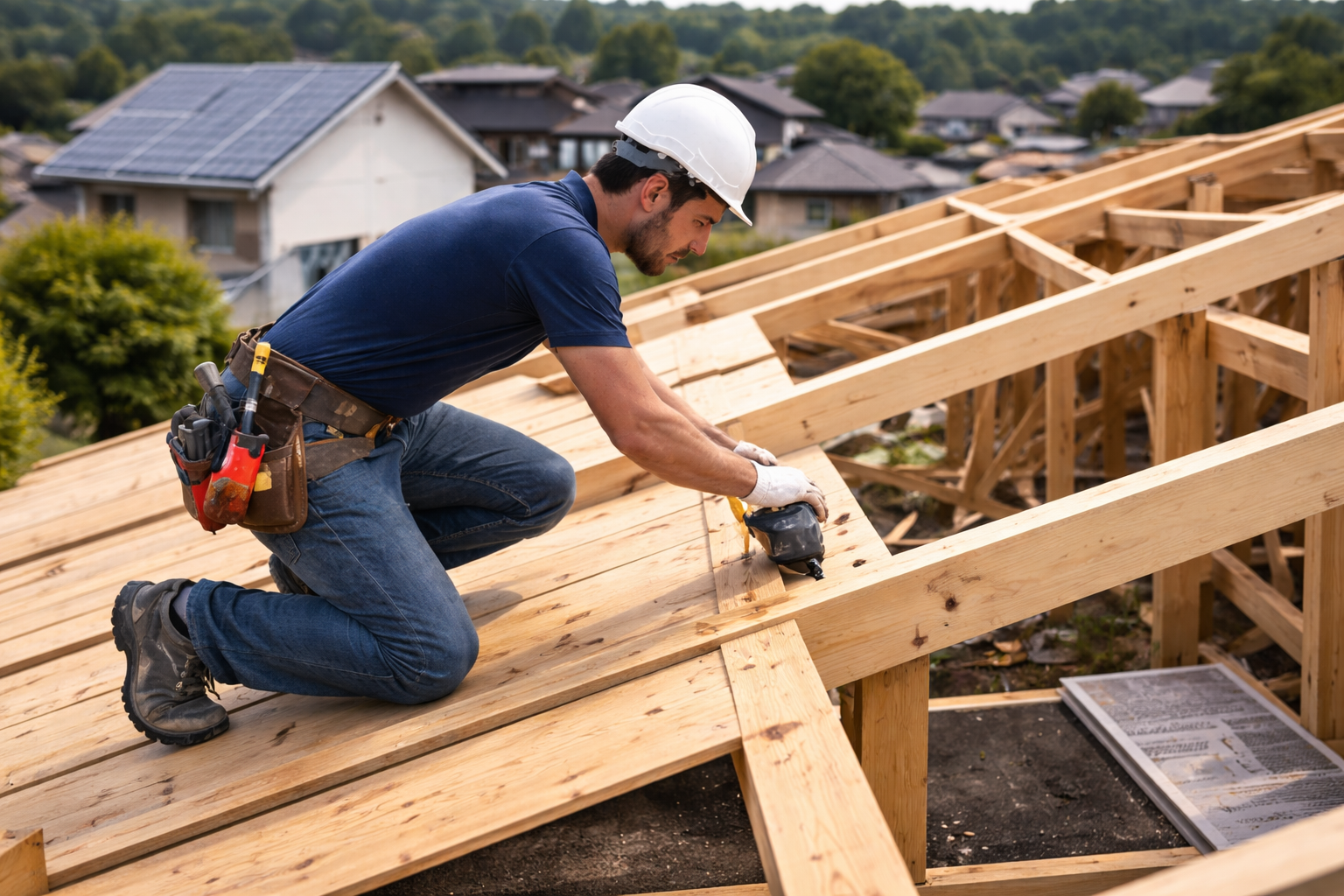

Hello everyone, this is DIY Renova.
Changing the shape of the roof (hipped, gabled, single-sided, beckoning roof, etc.) is considered quite romantic in the self-renovation world. The appearance changes all at once, and it's easy to set goals like ``creating a shape with less risk of leaks'' and ``making future maintenance easier.''
However, at the same time, changing the shape of the roof is also an act of touching on all the elements that affect the performance of the house. Specifically, "wind", "snow", "height/legal regulations", "workability (slope)", "difficulty of rain cover", "future scaffolding costs", etc. If you don't hold on to this point and move forward with momentum, you're likely to experience regrets that gradually take effect after the project is completed.
This article will thoroughly organize the points you should check before changing the shape of your roof, from a DIY perspective (I will not discuss construction details; I will focus only on what is necessary for deciding whether to change the shape).
If you're wondering "How much renovation or remodeling can I actually do on my own home?" or "Where should I even start?", please visit this page. If you're looking to learn more about specific renovation processes or construction details, don't miss this page as well!
Information on updates to this website will be delivered to you once a month.NewsletterIf you are interested, please register.
Please note that this document is not necessarily accurate, and should be used as reference information only.
So, here you go.
First of all, the main premise: changing the roof shape is easy to touch on the “main structural parts”
Roofs are treated as "main structural parts" under the Building Standards Act (*However, "eaves" etc. are sometimes excluded from main structural parts) (Source: Concept of definition of main structural parts) Resident Business Co., Ltd.)。
In recent years, the Ministry of Land, Infrastructure, Transport and Tourism has clarified that "large-scale renovations" of wooden detached houses are subject to building certification procedures. In particular, it is important to note that the handling changes depending on the timing, such as "construction will begin after April 2025" (Source: Ministry of Land, Infrastructure, Transport and Tourism materials) Ministry of Land, Infrastructure, Transport and Tourism.)。
What I'm trying to say here is not that ``if it's DIY, there's no need to apply,'' but rather that when changing the shape of a roof, it's often necessary to check regulations, structure, and safety.
The more you do it yourself, the more your prior design decisions will determine the cost performance.
Wind issues: The shape of the roof changes the way it sucks up (negative pressure)
In areas where typhoons and seasonal winds are strong, differences in roof shape are directly linked to the uplift force (the force that causes the roof to lift). Particularly dangerous areas are eaves, verges, ridge ends, and corners. In wind engineering, it is known that the lower the building is, the more likely local wind pressure (peak) is to become dominant (Source: Examples of research reviews on local wind pressure in low-rise buildings) science direct). In design practice, the idea is to treat the wind load on the roof surface using external pressure coefficients, etc., and to superimpose horizontal wind and roof wind loads (Source: AIJ materials wind.arch.t-kougei.ac.jp)。
From a DIY perspective, what is more important than formulas is whether changing the shape will increase or decrease the number of dangerous parts.
Rough idea of wind risk by shape (concept)
- Hipped roof: Because it flows in all directions, the wind is easily dispersed. The verge (edge on the wife's side) tends to decrease.
- Gable: Gable side can be formed. Depending on the wind direction, negative pressure peaks can easily occur at the gable end.
- Single-sided flow: Depending on the wind direction, the direction of "turning" is likely to be fixed. In particular, a design concept is needed to fit around the edges and ridges on the high side.
The conclusion here is simple: the stronger the wind is, the more you need to consider the structure (fixing and wind resistance) when choosing a shape with more edges or a shape that fixes the direction of turning.
If you just ignore the flow based on ``looks'', you will feel anxious every time there is a typhoon.
Is it the slope that people put on the roof? Directly linked to future repair costs
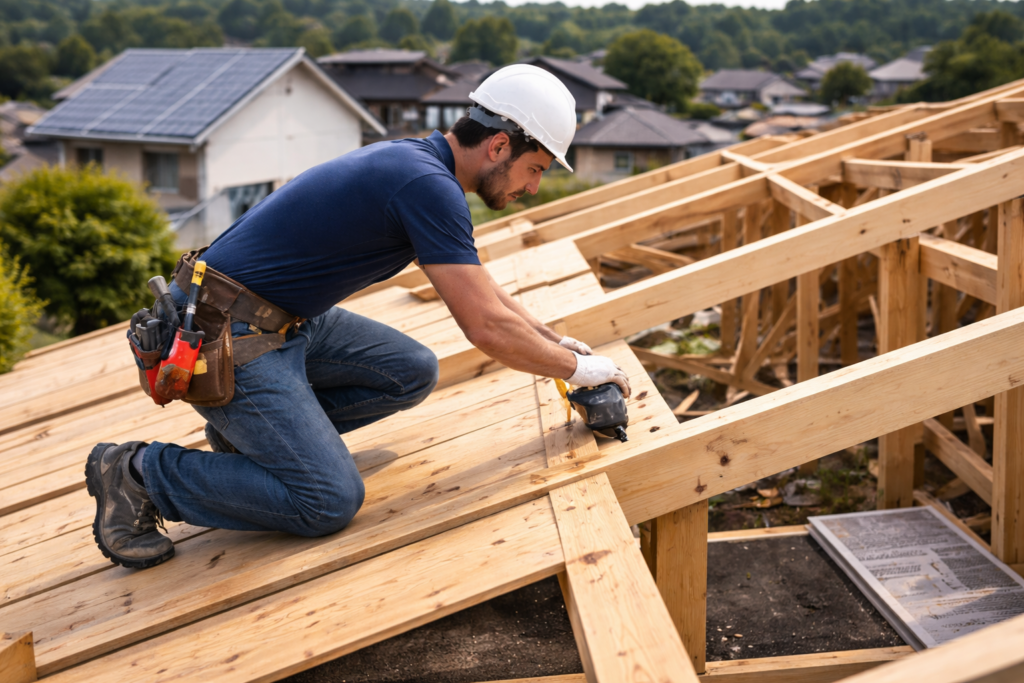
``Is it loose enough to stand up during construction?'' is a very important question. This is because a roof with a steep slope not only makes it difficult to DIY, but even if you hire a professional in the future, you will likely need ``roof scaffolding'' (a work platform for the roof), which will increase the cost of the scaffolding.
Occupational safety materials state that it is inappropriate to consider the roof surface as a work floor, such as when the roof slope is ``6/10 or more'', and that scaffolding for the roof is recommended (Source: Ministry of Health, Labor and Welfare manual) Ministry of Health, Labour and Welfare). Even in the safety standards for roofing construction, there is a statement that requires confirmation of roof scaffolding if the roof slope is 6/10 or more or the ground is slippery (Source: Example of roofing construction safety standards) kmew.co.jp)。
Slope guideline (for DIY judgment)
Slope is expressed in terms of ``dimensional slope'' or ``○/10,'' so converting it to angle makes it easier to judge.
- 3/10 (3 sun) = approximately 16.7 degrees: relatively walkable. Inspection and cleaning are realistic.
- 4/10 (4 sun) = approximately 21.8 degrees: This zone is common in general homes.
- 6/10 (6 sun) = approx. 31.0 degrees: Entrance to the zone where the roof surface is difficult to use as a work surface (a safety document line will appear). (Source: Ministry of Health, Labor and Welfare Ministry of Health, Labour and WelfareP15)
- 8/10 (8 sun) = approximately 38.7 degrees: My feet are scary. The risk of falling increases.
- 10/10 (10 sun) = 45 degrees: Now closer to the wall. In the future, repairs will likely be outsourced.
The important thing is not to decide on the angle based solely on how cool it looks when completed.
When looking at the future 10 or 20 years, the key decisions to make are ``Can I improve myself?'' and ``If not, can I tolerate the outsourcing costs?''
Probably this, not "slanting sun": diagonal line restrictions, shade restrictions, height restrictions
I believe that the draft ``Law of Oblique Sunlight'' refers to ``diagonal line restrictions'' and ``sunshade restrictions'' in context. If you change the shape of your roof, the maximum height, eave height, and outer shape will change, making it easier to get caught in these areas.
Diagonal line restrictions (road diagonal lines, adjacent land diagonal lines, northern diagonal lines)
Diagonal line restrictions are a mechanism to limit the height and shape of buildings in consideration of the surrounding lighting and environment, and are organized as group regulations in documents from the Ministry of Land, Infrastructure, Transport and Tourism (Source: Ministry of Land, Infrastructure, Transport and Tourism's "Building Standards Act (Group Regulations)") Ministry of Land, Infrastructure, Transport and Tourism)。
Changing the shape of the roof may cause the ridge to rise or the gable to rise, which may unexpectedly exceed the diagonal line.
This is an effective DIY point.
There are many cases where it is a violation to change the roof even though the floor plan has not changed. This is especially likely to occur when conditions overlap, such as in urban areas, semi-fire protection areas, and high altitude areas.
Shade regulations (height restrictions for medium and high-rise buildings)
Shade regulations are related to ordinance specifications, but at least lines such as ``eaves height over 7m'' and ``height over 10m'' come into play (Source: Examples of local government explanations (Maebashi City) Maebashi City official website)。
In addition, the system's explanatory materials also indicate that "buildings with eaves over 7m in height" are eligible depending on the zone of use (Source: Ministry of Land, Infrastructure, Transport and Tourism) Ministry of Land, Infrastructure, Transport and Tourism)。
In other words, when changing the shape of your roof, you must check not only the maximum height but also the eave height. Even in a two-story building, raising the slope or creating a higher side with one side flow will make it easier to get closer to the eave height line.
Does the length of the eaves affect the building coverage ratio? There are some serious accidents here.
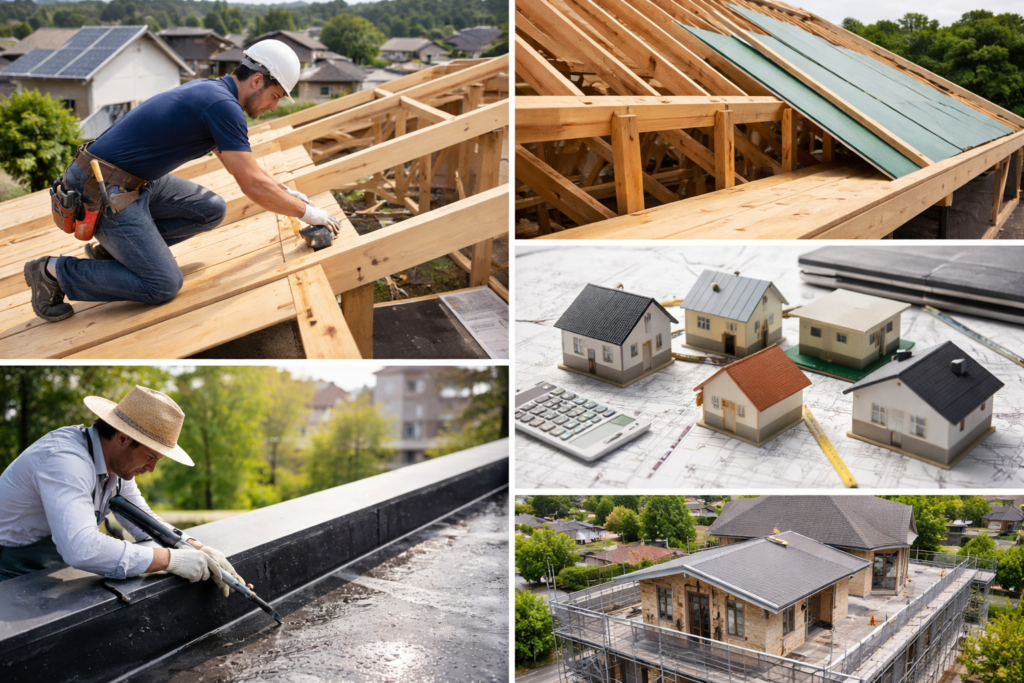
When you change the shape of your roof, you'll want to change the eaves as well. I understand the desire to put out the eaves, both in terms of rain protection and appearance.
However, in calculating the building coverage ratio, eaves and eaves may be included in the "building area," and the standards are written on the definition side of the law (enforcement order). The building area is basically the horizontal projected area surrounded by the center line of the exterior walls, etc., and the treatment is stipulated when eaves, eaves, etc. extend beyond a certain level (Source: e-Gov "Definition of Article 2 of the Building Standards Act Enforcement Order" e-Gov Legal Search)。
What's even more confusing is that ``eaves will be exempted from 1m to 5m''. This is the rationalization of large-scale eaves such as distribution warehouses, and there are requirements (Source: Ministry of Land, Infrastructure, Transport and Tourism materials) Ministry of Land, Infrastructure, Transport and Tourism.)。
In a house, you don't say, "Okay, even if the eaves are 5m, it doesn't fit into the building coverage ratio!" If you misunderstand this, you will get stuck at the planning stage.
The countermeasure from a DIY perspective is simple: If you want to change the shape of your roof, before changing the eaves, ask the government or designer if it will be included in your case based on the usage and conditions. This is the shortest.
Snow problem: Changing the roof shape causes "unbalanced load"
There are large regional differences in Japan, but in areas where snow is involved, the shape of the roof changes the load. Moreover, what is scary is not just the fact that the weight is evenly piled up, but also the fact that blizzards and wind create snowdrifts that result in uneven loads. In construction in snowy and cold regions, snowdrifts are considered to be an important issue that can lead to uneven loads and burying of evacuation routes (Source: J-STAGE paper) J-STAGE)。
In addition, the snow load is subject to calculation in the framework of the Building Standards Act, and there is an idea (roof shape factor) that it can be reduced by changing the roof slope (Source: Article 86 of the Enforcement Ordinance is cited in the document) Enechen.)。
The key point is that if you change the shape, the places where snow falls/accumulates will change.
Snow troubles that are likely to occur due to shape changes (how to think)
- Unilateral flow: The direction of snowfall is fixed. If your plan is such that snow is likely to fall on neighboring properties, walkways, and entrances, it will be hell later on.
- Stepped roof (hanging/inviting): Drifts are likely to form in valleys and steps. Typical pattern where unbalanced loads occur.
- Hip ridge: Easily dispersed, but local accumulations may occur depending on the direction of the wind.
If you want to change the shape of your roof in a snowy country, the key decision-maker to consider is whether it has an exterior shape that makes it difficult for unbalanced loads to occur (as unbalanced loads tend to be directly linked to problems with the structure), rather than how easy it is to remove snow.
Difficulty level of rain closure: The more complex the shape, the more “troughs” there will be.
I won't talk about construction, but there are some golden rules that can be said just from the shape.
The more complex the roof shape, the more
- Valley (the line where the roof meets on the inside)
- Interaction (point of contact with the wall)
- step part
will increase.
And rain leaks occur not in "planes" but in "lines" and "points."
In other words, if you want to change the shape of your roof, ``reducing valleys and steps is the best option in the long term.''
It is reasonable to reduce maintenance costs by simplifying the roof shape. If you want to change the shape, "reducing the lines" is just as important as your aesthetic preference.
Maintenance cost: “Future scaffolding costs” are determined by slope and shape
I would like to clarify the topic of future costs one more time.
- Steep slope: Roof scaffolding is likely to be required (according to safety documents, slopes of 6/10 or more tend to be inappropriate as work floors). (Source: Ministry of Health, Labor and Welfare Ministry of Health, Labour and Welfare)
- Complex shape: More inspection points = higher repair cost (the more valleys, steps, and joints there are).
- Unilateral flow: Since the flow is concentrated on one side, the design tends to increase the burden on the rain gutter/drainage side (inevitable due to the shape).
If you want to change the shape of your roof with DIY, the best bet is to imagine how the scaffolding will look 10 years from now, rather than 1 year after completion.
By shape type: Suitable conditions (judgment table)
| Roof shape | Suitable conditions | Points to note (due to shape) |
|---|---|---|
| gable | Simple orientation, emphasis on ease of construction | The end on the gable side/effect of wind direction, the gable is likely to be hit by diagonal lines |
| hipped building | I want to organize the appearance in areas with strong winds. | The shape is easy to stabilize, but as the number of ridges and corner ridges increases, the number of lines increases. |
| one side flow | Create ceiling height to sharpen the appearance | Fixed direction of turning, easy to increase eave height and maximum height, fixed snowfall direction |
| Stepped roof (invitation, etc.) | Prioritize design and take advantage of daylight | Valleys and steps are likely to increase = maintenance management difficulty increases, risk of unbalanced snow load |
This table is not meant to tell you which is the correct answer, but to help you visualize the quirks of the shape first.
Procedure for determining shape change (for DIY, to prevent children from getting lost)
I'll write it here as a step-by-step guide. This is not a construction procedure, but a "decision procedure."
Step 1: Fix your purpose in one word
Example:
- "Reducing the risk of rain leaks"
- "In the future, we will make the slope so that you can inspect it yourself."
- "Move to an outer shape that is not exposed to diagonal lines or shadows"
If the purpose is not clear, the number of shape ideas increases endlessly.
Step 2: Check the regulations before deciding on the external shape
Minimum check:
- Use zone, diagonal line restrictions, presence of shade restrictions (Source: Ministry of Land, Infrastructure, Transport and Tourism Group Regulations) Ministry of Land, Infrastructure, Transport and Tourism, municipal example Maebashi City official website)
- Estimated eave height/maximum height
- Does the protrusion of the eaves affect the building coverage ratio? (Source: Definition of Enforcement Ordinance e-Gov Legal Search)
Step 3: Eliminate one “habit” of wind and snow
- Strong winds: avoid shapes with more edges, one-sided flow has an edge design concept (Source: AIJ materials wind.arch.t-kougei.ac.jp)
- Snow involved: Avoid contours with steps, valleys, and snowdrifts (Source: Blizzard Research J-STAGE)
Step 4: Decide on the slope as “the line you can climb”
Safety documents also state that a slope of 6/10 or higher is likely to be inappropriate as a work floor, so it is worth keeping this in mind if you are planning on DIY. (Source: Ministry of Health, Labor and Welfare) Ministry of Health, Labour and Welfare)。
Checklist (If you answer yes to all 15 items, it's pretty solid)
- The purpose can be expressed in one word
- The maximum height and eave height are estimated.
- The external shape does not fall under the diagonal line restriction (Source: Ministry of Land, Infrastructure, Transport and Tourism) Ministry of Land, Infrastructure, Transport and Tourism)
- Confirmed whether the conditions covered by the sunshade regulation were met (Source: Local government example) Maebashi City official website)
- We have understood the handling of building confirmation procedures after 2025 (Source: Ministry of Land, Infrastructure, Transport and Tourism) Ministry of Land, Infrastructure, Transport and Tourism.)
- Confirmed whether the protrusion of the eaves affected the building coverage ratio (Source: Enforcement Ordinance Definition) e-Gov Legal Search)
- "Large-scale eaves reduction for warehouses" has not been incorrectly applied to housing (Source: Ministry of Land, Infrastructure, Transport and Tourism Ministry of Land, Infrastructure, Transport and Tourism.)
- In areas with strong winds, the edges are not shaped to increase (Source: AIJ wind.arch.t-kougei.ac.jp)
- I understand that in the case of one-sided flow, the direction of turning is fixed.
- In areas where snow is involved, do not easily choose a shape with stepped roofs and valleys (Source: Snowstorm Research J-STAGE)
- The direction of snowfall is not toward the neighboring property, walkway, or entrance.
- If the slope is 6/10 or higher, future roof scaffolding costs are factored in (Source: Ministry of Health, Labor and Welfare) Ministry of Health, Labour and Welfare)
- As a result of changing the shape, "valleys/steps" have not increased (the more lines there are, the more difficult maintenance becomes)
- Future inspection flow line (self or contractor) is realistic
- It is understood that after completion, ``there are more regulations to follow than before the change'' (Source: Ministry of Land, Infrastructure, Transport and Tourism) Ministry of Land, Infrastructure, Transport and Tourism)
effective tool
At the stage of considering changing the roof shape, it is better to have fewer tools, but systems that help make decisions are a good match.
- "Digital angle meter (for slope confirmation)":
- “Full harness type fall arrest device”:
- "Simple anemometer": As an aid for on-site judgment
Summary: When changing the shape of a roof, a design that helps ``you in 10 years'' wins over ``looks.''
The shape of the roof is a part that determines the character of the house. However, when it comes to DIY, the top priorities are safety, legal regulations, and future maintenance. ``Is it a slope to build?'' is an extremely important point that is directly linked to future costs.
And just one last time. Roofs are easily accessible to major structural parts, and system operations are changing. Because it is a DIY project, the shortest route is to check the primary information from the Ministry of Land, Infrastructure, Transport and Tourism and quickly determine where your construction falls under (Source: Ministry of Land, Infrastructure, Transport and Tourism) Ministry of Land, Infrastructure, Transport and Tourism.)。
If you're wondering "How much renovation or remodeling can I actually do on my own home?" or "Where should I even start?", please visit this page. If you're looking to learn more about specific renovation processes or construction details, don't miss this page as well!
Information on updates to this website will be delivered to you once a month.NewsletterIf you are interested, please register.
References/Materials (Respect)
- Ministry of Land, Infrastructure, Transport and Tourism "Building Standards Act (Group Regulations)" materials (Overview of diagonal line restrictions, etc.) (Ministry of Land, Infrastructure, Transport and Tourism)
- Ministry of Land, Infrastructure, Transport and Tourism "Building confirmation procedures for large-scale renovation of wooden detached houses" materials (handled from 2025 onwards) (Ministry of Land, Infrastructure, Transport and Tourism.)
- e-Gov law search “Building Standards Act Enforcement Order” term definition (building area, etc.) (e-Gov Legal Search)
- Ministry of Land, Infrastructure, Transport and Tourism materials “Operation Improvement Cabinet Order” etc. (organizing the handling of large-scale eaves) (Ministry of Land, Infrastructure, Transport and Tourism.)
- Ministry of Health, Labor and Welfare “Work Standard Manual for Installing Safety Equipment to Prevent Falls” (Roof Slope and Safety Concepts)Ministry of Health, Labour and Welfare)
- Tamura, Y. et al.: AIJ-related wind load materials (concepts of roof wind loads) (wind.arch.t-kougei.ac.jp)
- Takuya Tsutsumi (2009) “Current status of snowstorm research in the architectural field” (importance of snowdrifts and unbalanced loads) (J-STAGE)
- Maebashi City “About Shading Regulations” (as an example of specific municipal rules) (Maebashi City official website)
 English
  Japanese
Leave a Reply
You must be logged in to post a comment.