
Hello everyone, this is DIY Renova.
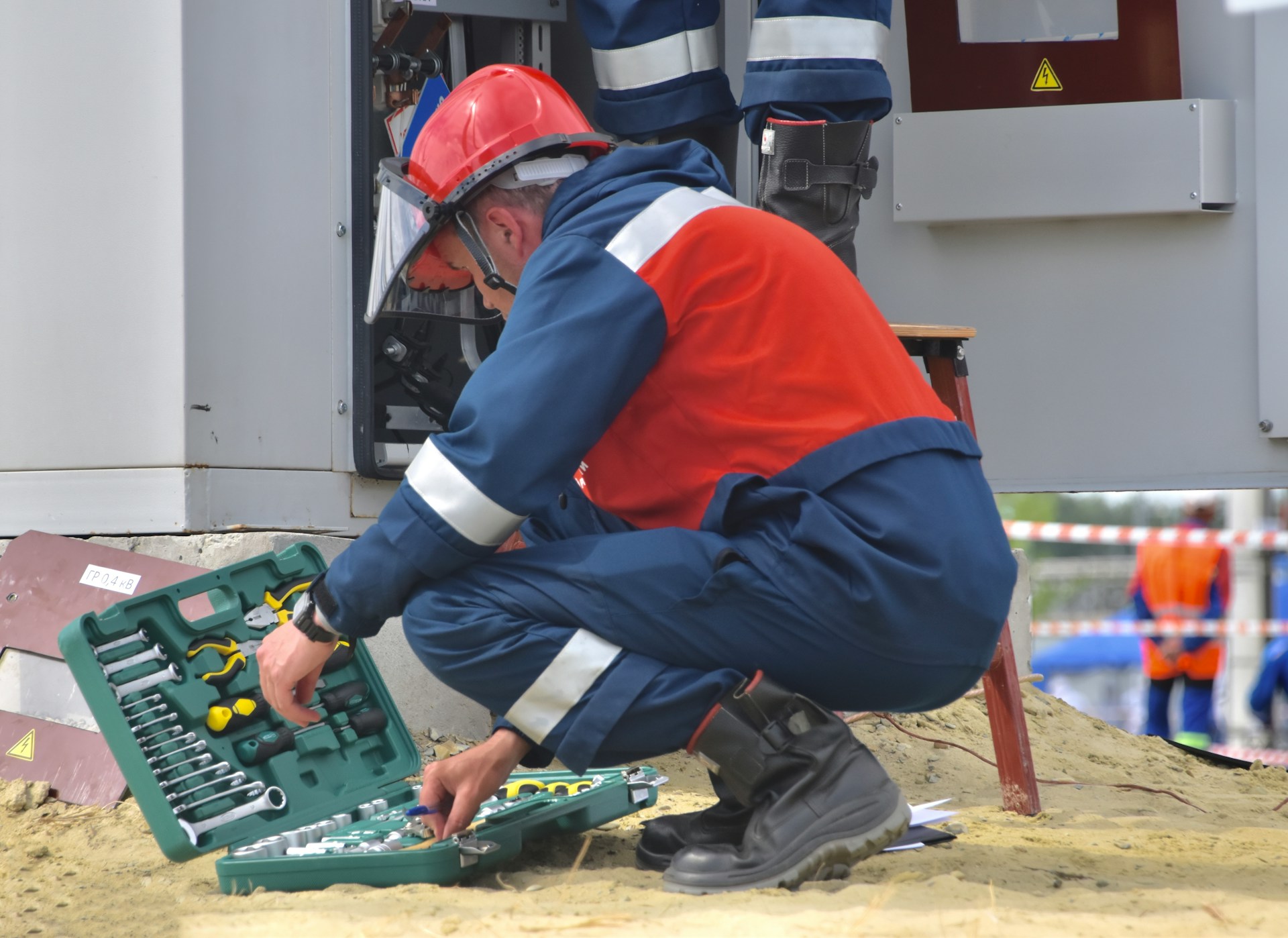
Congratulations on passing the second class electrician exam. When you receive your license, you tend to think, ``Okay, now I can proceed with renovating your home's equipment,'' but from this point on, it's easy to see that ``the difference in tools is the difference in safety and quality.''
In this article, we will introduce the tools, measuring instruments, protective equipment, and consumables that you should prepare when you are self-renovating home equipment (lighting, switches/outlets, around the distribution board, ventilation, part of the external wiring, etc.).Be sure to each
- “Which point should I be careful about?”
- “Which points are useful and should I purchase?”
I will summarize from this perspective. While focusing on Japanese stories, I will also include ``standards'' and ``ways of thinking'' so that they can be understood by DIYers overseas.
If you're wondering "How much renovation or remodeling can I actually do on my own home?" or "Where should I even start?", please visit this page. If you're looking to learn more about specific renovation processes or construction details, don't miss this page as well!
Information on updates to this website will be delivered to you once a month.NewsletterIf you are interested, please register.
Please note that this document is not necessarily accurate, and should be used as reference information only.
So, here you go.
First: Reconfirm what you can and cannot do with your qualifications (if you are vague about this, everything is at risk)
Class 2 electricians are eligible for work on "general electrical facilities, etc." (framework of the Electrical Contractors Act). In other words, it is mainly used for indoor wiring and small-scale equipment in general homes and shops.
On the other hand, there is also a scope of work that is considered ``minor work that does not require qualifications,'' and this is summarized in materials from the Ministry of Economy, Trade and Industry.
- Points to note:
It is not just that ``you can do anything'', but rather that ``work that requires qualifications'' and ``minor work that does not require qualifications'' are classified by the Electrician Law, Enforcement Order, and Enforcement Regulations. If you step into boundaries without confidence, you increase the risk of accidents and the cost of redoing. - These are useful and should be purchased:
``Be able to view the Ministry of Economy, Trade and Industry's organized materials on one page.'' Rather than looking at the full text of the law, the quickest way is to have a map of work divisions on hand (just printing out the materials and putting them in your toolbox can be very effective).
Priority conclusion: First of all, "stopping safely, checking, and recording" is the top priority
What's really scary about self-renovated electricity is a lack of confirmation rather than a lack of technology. Therefore, the correct choice for your first purchase is one that will ``eliminate electric shocks, short circuits, and erroneous energization'' before purchasing a screwdriver. In addition, the interpretation of Japanese technical standards organizes the concept of protection such as earth leakage circuit breakers.
Required: Protective equipment (PPE) and “personal protection” set
1) Electrical insulation gloves (JIS compliant)
What does the tool do?
These are "rubber gloves for electrical use" to reduce the risk of electric shock. Their purpose is different from ordinary work gloves or work gloves.
- Points to note:
Do not confuse "anti-static gloves" with "electrical insulation gloves." If you want to use it as a protection against electric shock, select it based on the classification of JIS T 8112 (electrical insulating gloves). The JIS revision has organized the concept of J00 (AC/DC 300V or less). - These are useful and should be purchased:
The voltage class used must be clearly specified, such as J00 (300V or less). This idea is realistic for residential 100V DIY. Furthermore, the "thin and well-fitting" model reduces stress when tightening terminals and doing detailed work (fit = continuous ability to confirm safety). - Buying tips:
AmazonやYahooなら「絶縁手袋 JIS T8112 J00」で検索し、商品ページにクラス表記があるものを選ぶのがおすすめです。
2) Safety glasses (preferably goggles)
What does the tool do?
Protects your eyes from chips, dust, and debris. Electricity doesn't seem to have anything to do with the eyes, and drilling, box processing, and ceiling work hurt the eyes.
- Points to note:
Electricity is not only an ``invisible danger,'' but it also comes with chips, dust, and debris that can irritate your eyes. Electrical installation work causes many eye accidents. - These are useful and should be purchased:
``Anti-fog'' ``Shaped to prevent dust from entering from above'' ``Can be worn over glasses''. This alone will increase the wear rate and reduce injuries as a result.
Required: Confirmation measuring device (tool that can prove that it is “stopped”)
3) Voltage detector (non-contact + contact concept)
What does the tool do?
This is a tool to check whether electricity is coming to that line. This is used to confirm that the electricity is truly cut off before starting work.
- Points to note:
Electrical detection is the "last lifeline", but if you do not understand the characteristics of the tool, it can lead to false positive results. While non-contact types are convenient, their reactions vary depending on the environment and wiring conditions. - These are useful and should be purchased:
``Self-diagnosis (battery/operation check)'' ``Thin tip (easy to hit inside the board)'' ``Both sound and light''. DIY sites are noisy, dark, and have bad posture, so just having two notification systems will reduce false positives.
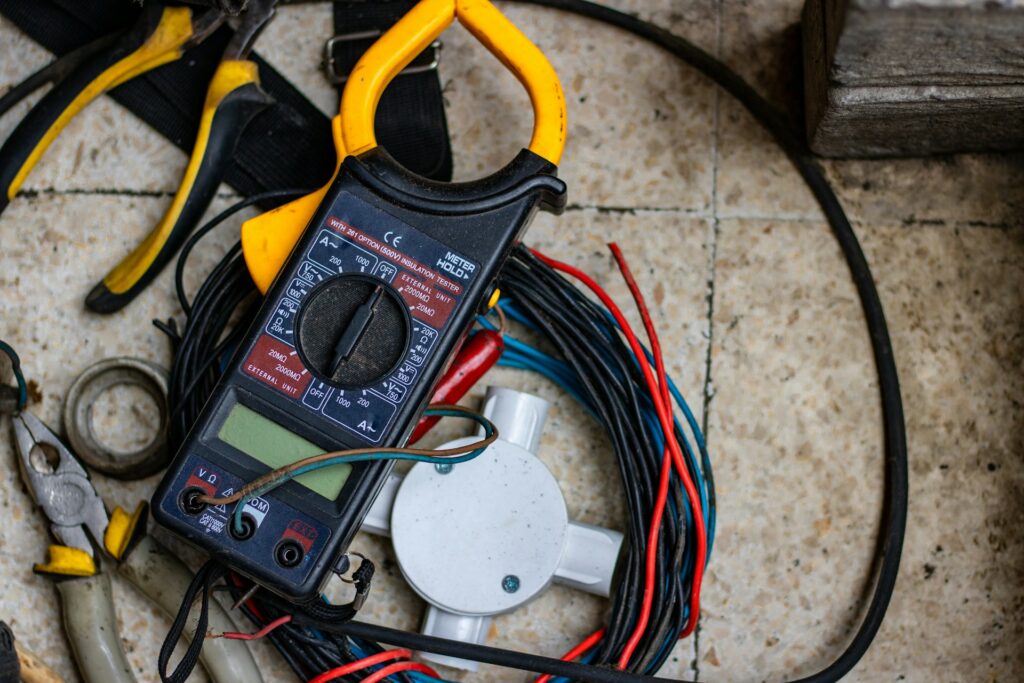
5) Tester/multimeter (understand and choose measurement category CAT)
What does the tool do?
It is a tool that numerically measures voltage (how many volts), resistance (whether there is a connection), continuity (whether a wire is running through it), etc. If the voltage detector says "Is electricity coming in?", the tester can check "How many volts are coming in? Is it really turned off?"
- Points to note:
Although testers can measure anything, they can be dangerous if used in the wrong place. The IEC/JIS measurement categories (CAT II/III/IV) are safety classifications that ``the higher the transient energy is, the higher the category is required''. - These are useful and should be purchased:
``Certification of CAT III (assuming distribution boards and fixed wiring in buildings) or higher'' ``Complete safety explanations from Japanese manufacturers'' ``Fuses are of appropriate standards and easy to replace.'' The category notation is also called out on the manufacturer's explanation page. - Buying tips:
If you search for "Tester CATIII 600V" on Amazon or Yahoo, and choose one with clear CAT notation in the spec column, you will be less likely to make a mistake.
6) Clamp meter (“view the current without cutting it”)
- Points to note:
If you try to measure current with a tester in series, you will have to touch the wiring more, which increases the risk. - These are useful and should be purchased:
"Slim clamp diameter (easy to clamp inside the panel)" "True RMS display" "Backlight". Being able to “see and clip” something inside the board is justice.
Required: Insulated tools (lower the “upper limit of accidents” based on the “possibility of touching”)
7) Insulated screwdriver (IEC 60900 / EN 60900 compliant)
A tool for tightening screws on outlets, switches, distribution boards, terminal blocks, etc. When it comes to electricity, "screw tightening" is directly linked to quality.
- Points to note:
Insulated tools are not a “universal indulgence”. Inspection and renewal are necessary on the premise that if the coating is chipped, it will be immediately removed. - These are useful and should be purchased:
"Clearly compliant with IEC 60900 (up to 1000V)". It's a common language overseas, and if the tools are labeled, you can feel safe on site. Compatibility will also be clearly indicated in the manufacturer's catalog.
8) Electrical pliers/nippers/stripper (accuracy of blade = reliability of finish)
What does the tool do?
This is a tool that removes only the outer vinyl (coating) of electric wires to reveal the copper wires inside.
It is also a tool that performs basic electrical work such as cutting, bending, lightly grasping, and partially stripping wires.
I must have used it in my practical skills when getting my electrician qualification! I think many of you already have it.
- Points to note:
Stripping methods that damage the core wire can cause deterioration, even if it looks beautiful. The Ministry of Land, Infrastructure, Transport and Tourism's standard specifications also clearly state that ``removal of the coating should be done to the minimum necessary to avoid damaging the core wire.'' - These are useful and should be purchased:
``VVF compatible strip hole'' ``Easy to grip spring'' ``Blade replaceability''. The quality of work is stable every time.- Also, it seems that a tool commonly known as ``Gacchan'' is often used as a stripper in the field. It is ideal for homes with a large number of wiring.
Required: Crimping/connection system (where the “difference in quality” appears in housing equipment renovation)
9) Crimping tool (use a compatible product: If you skimp here, you will regret it for a long time)
What does the tool do?
A tool that ``crimps'' electric wires and ``crimped terminals/sleeves'' together with strong force. Simply put, it is a tool that fixes electric wires with metal parts to create a connection that cannot be pulled out.
- Points to note:
When it comes to crimping, "tool compatibility" is the essence of quality. Even the standard specifications for public buildings clearly state that JIS C 9711 tools must be used for crimp connections. - These are useful and should be purchased:
``Compatible sleeve range is clear'' ``Ratchet mechanism (does not come out with constant pressure)'' ``Engravings appear clearly''. Even in DIY, ``reproducibility of crimping'' is the key.
10) Plug-in connectors/terminal blocks, etc. (achieves both “installability” and “inspectability”)
- Points to note:
The more convenient the connector, the more it has "conditions" such as compatible wire types, wire diameter, whether or not it can be twisted, and whether it can be reused. Anything outside of these conditions is a breeding ground for defects. - These are useful and should be purchased:
``Transparent housing (can confirm insertion)'' ``Test hole (tester can be applied)'' ``Removal prevention''. Being able to inspect things is the biggest insurance for DIY.
Required: Tools for opening, fixing, and creating wiring routes (electricity is determined “inside the building materials”)
11) Base search/detector (search for pillars/studs/metal/AC)
What does the tool do?
This is a tool for locating pillars (underlayment) and metal in walls, and in some cases, power lines. This is an “accident prevention radar” before drilling.
- Points to note:
The process of drilling holes in walls and ceilings destroys building materials before electricity does. It's even worse if you hit the existing wiring. - These are useful and should be purchased:
``Detection of wood + metal + live wire'' ``Easy calibration'' ``Less reaction quirks''. DIY tends to rely on "feel", so it is wise to use a machine to correct it.
12) Hole saw/step drill/box tool
What does the tool do?
A tool for making round holes in walls and ceilings, and for processing around boxes for wiring devices (switches and outlets).
- Points to note:
Drilling produces dust. If you do not use PPE (protective equipment), your eyes, throat, and lungs will be damaged. - These are useful and should be purchased:
"Hard to produce burrs", "Proven track record in woodworking and plasterboard", "Replaceable blades available". After all, replaceable tools are cheaper in the long run.
Required: Labeling/Recording (Equipment to help your DIY “future self”)
13) Label writer (name circuits, boards, and cables)
What does the tool do?
A tool for pasting "names" on distribution boards, wiring, the back of switches, etc. Create a state that you can see later.
- Points to note:
The most dangerous situation with electricity is when you cannot follow up. Future inspections, changes, and troubleshooting will be covered. - These are useful and should be purchased:
``Water and weather resistant tape'' ``Compatible with heat shrink tubes (if possible)'' ``Template function''. Just having this will make the inside of the board look “professional” and actually make it safer.
14) Recording format for wiring check (paper is also OK)
- Points to note:
I forget it halfway through. I'll definitely forget. Because it's human. - These are useful and should be purchased:
This format leaves information about when, where, and what was changed. At the very least, the breaker number/circuit name/changes/photos are sufficient.
Consumables: If you always have these in your “on-site box”, your work will never stop.
15) Insulating tape, self-adhesive tape, curing tape (do not mix uses)
- Points to note:
The most dangerous thing about tape is that you can put it on anything. Separate items for insulating purposes, fixing purposes, and curing purposes. The Ministry of Land, Infrastructure, Transport and Tourism specifications also mention insulating the connections, but it is important to keep in mind that the same or higher effectiveness is required. - These are useful and should be purchased:
``Electrical insulating tape (specifies purpose)'' ``Adhesive does not fall off even in cold weather'' ``Color-coding (can also be used to identify circuits)''.
16) Cable ties, wire fasteners, stickers
- Points to note:
The “look” of the wiring is safety itself. Loose wiring can cause disconnection, contact, and heat. - These are useful and should be purchased:
``Weatherproof (outdoor)'', ``set of different widths'', ``re-binding type''. The lifespan of the product will change just by using it properly outdoors and indoors.
Great to have: “Recommended equipment” that will make home equipment renovation even easier
17) Rechargeable lights (neck/headlights)
- Points to note:
Darkness = more confirmation errors = danger. Especially the inside work. - These are useful and should be purchased:
``Your hands are not occupied'', ``natural colors (wire colors are easy to distinguish)'', and ``long hours''.
18) Torque management (increase tightening reproducibility)
- Points to note:
Too tight or too loose will cause problems. In particular, "proper tightening" of terminals is directly linked to quality. - These are useful and should be purchased:
``Compatible with small torque'' ``Manufacturer with calibration and reliability.'' At first, it is effective for "correcting the quirks of your hands."
19) Choosing to “buy” the Extension Regulations (JEAC8001)
- Points to note:
Although it is a private standard, it is easily referenced in design, construction, and maintenance management. It is also clearly stated that it has been published and revised as the latest version (JEAC8001-2022). - These are useful and should be purchased:
Being able to “get back to the basics at hand”. There will always be times when you get confused when doing DIY, so having a reference book will help you avoid accidents and reduce rework.
“Checklist before purchasing”: If you only check this in the specs section, you will be less likely to make mistakes.
- "Specification of conformity to standards": JIS T 8112 for insulated gloves, IEC 60900 for insulated tools, etc.
- "Applications and conditions": The connector's wire type, wire diameter, and whether or not it can be twisted.
- "Inspection and renewal": Tools with chipped insulation must be replaced. There are also warnings in the manufacturer's documentation.
- "Measurement Category CAT": Tester checks CAT notation and applicable location. Domestic manufacturers are also issuing a warning.
Finally: Japanese housing equipment is strong if you consider the "idea of protective equipment" as a set.
Japan's ``Interpretation of Technical Standards for Electrical Equipment'' clearly states the concept regarding electric shock prevention and earth leakage circuit breakers. For example, earth leakage circuit breakers (rated sensitivity current 15 mA or less, operating time 0.1 seconds or less) are mentioned depending on the conditions.
It is not necessary to recreate everything perfectly with DIY, but knowing the ``philosophy of protection'' will help you make decisions when choosing tools and planning construction.
If you're wondering "How much renovation or remodeling can I actually do on my own home?" or "Where should I even start?", please visit this page. If you're looking to learn more about specific renovation processes or construction details, don't miss this page as well!
Information on updates to this website will be delivered to you once a month.NewsletterIf you are interested, please register.
Please note that this document is not necessarily accurate, and should be used as reference information only.
References/Reference materials
- Ministry of Economy, Trade and Industry. (n.d.). Safety of electrical work.
- Ministry of Economy, Trade and Industry. (n.d.). What is "minor construction" that does not require electrician qualifications [PDF].
- Ministry of Economy, Trade and Industry. (n.d.). Scope of engagement of electricians, etc. [PDF].
- e-Gov Law Search. (1960). Electrician Law (Act No. 139 of 1960).
- Ministry of Land, Infrastructure, Transport and Tourism. (2025). Public construction work standard specifications (electrical equipment work edition) Reiwa 7 edition [PDF].
- Ministry of Economy, Trade and Industry. (2025). Interpretation of technical standards for electrical equipment [PDF].
- Japan Electrical Association, General Incorporated Association (2022). Extension Regulations 14th Edition JEAC8001-2022 (JESC E0005(2022)).
- Ministry of Health, Labor and Welfare. (n.d.). Standards for insulating protective equipment, etc. (Ministry of Labor notification).
- KTC. (n.d.). INSULATED TOOLS [PDF].
- TRUSCO. (2025). Insulated gloves (including explanations regarding JIS T8112) [PDF].
- Sanwa Electric Meter Co., Ltd. (n.d.). Safety Explanation (Measurement Category).
- HIOKI. (2025). [General] About measurement categories Safety standards.
 English
  Japanese
Leave a Reply
You must be logged in to post a comment.