
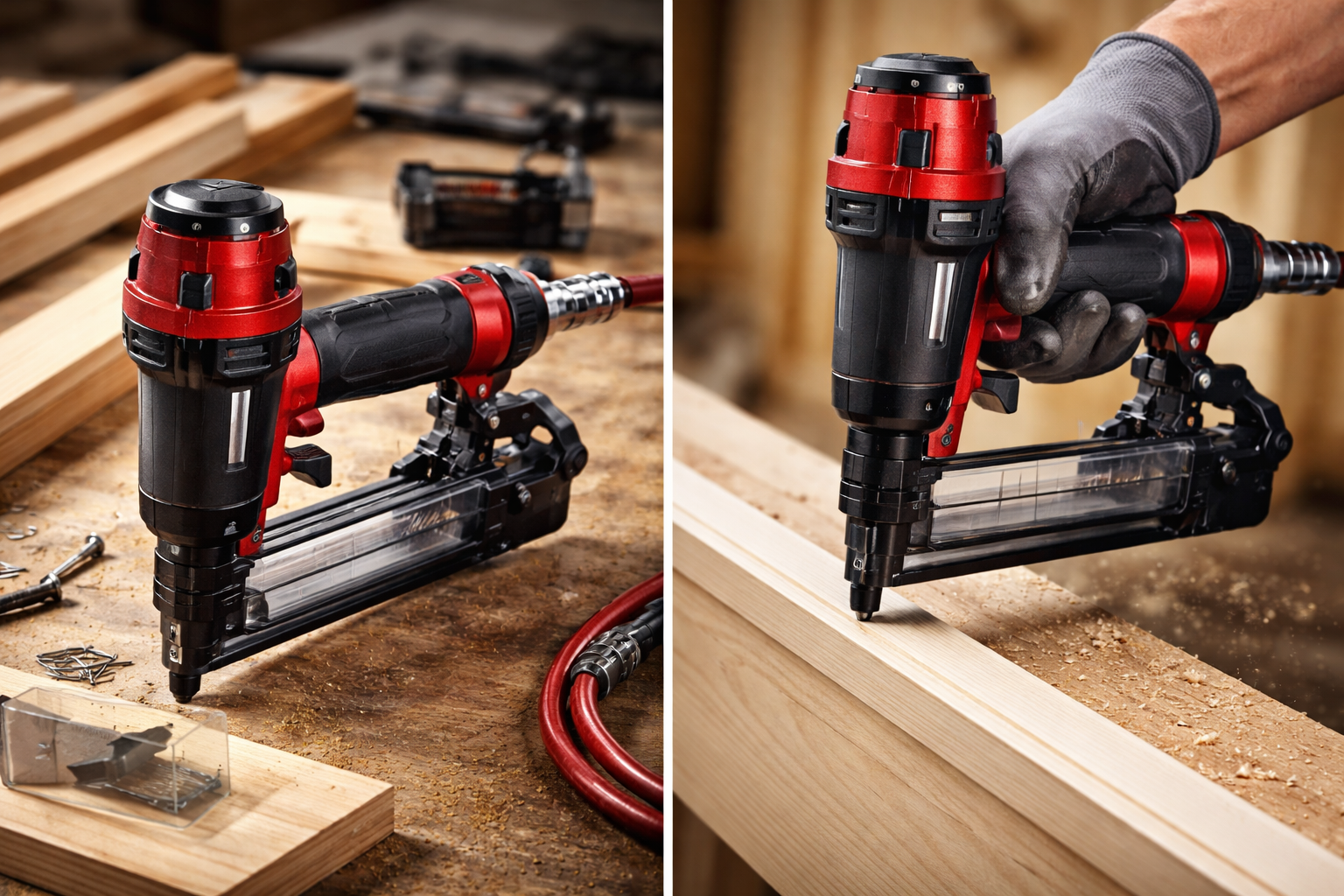
When you start seriously doing self-renovation, you will probably think about this at least once.
"It's slow to fasten with screws." "It's tiring to do it by hand." "But there are so many different types of nail guns that it's scary."
If you choose the right nail gun, it will improve your work speed, uniformity of finish, and physical energy consumption. However, if you choose the wrong one, the tool will not suit your purpose, the nails won't match, it's dangerous, and you'll end up having to buy it again. Moreover, the ``correct nail'' and ``correct machine'' will vary depending on the type of construction.
Personally, I would choose 65mm if I had to choose just one, considering its handling and usable range.
This article focuses on "nail gun" and summarizes the following:
- Types of nail guns and how to choose them according to their purpose
- Air type, rechargeable type, gas type, each is unsuitable
- How to choose nails (not just length, but also shaft, material, and plating)
- How to choose new/used/rental/secondhand stores and check the actual items
- Points to note to avoid accidents when DIY (with evidence)
- "Purchasing patterns" tailored to various people's conditions (budget, neighborhood, storage, amount of work)
While focusing on self-renovation of Japanese wooden houses, we will also add ideas that can be applied to overseas DIY projects. Add evidence to statements that are close to conclusive to increase transparency (e.g., manufacturer specifications, NIOSH safety guides, etc.).
If you're wondering "How much renovation or remodeling can I actually do on my own home?" or "Where should I even start?", please visit this page. If you're looking to learn more about specific renovation processes or construction details, don't miss this page as well!
Information on updates to this website will be delivered to you once a month.NewsletterIf you are interested, please register.
Please note that this document is not necessarily accurate, and should be used as reference information only.
So, here you go.
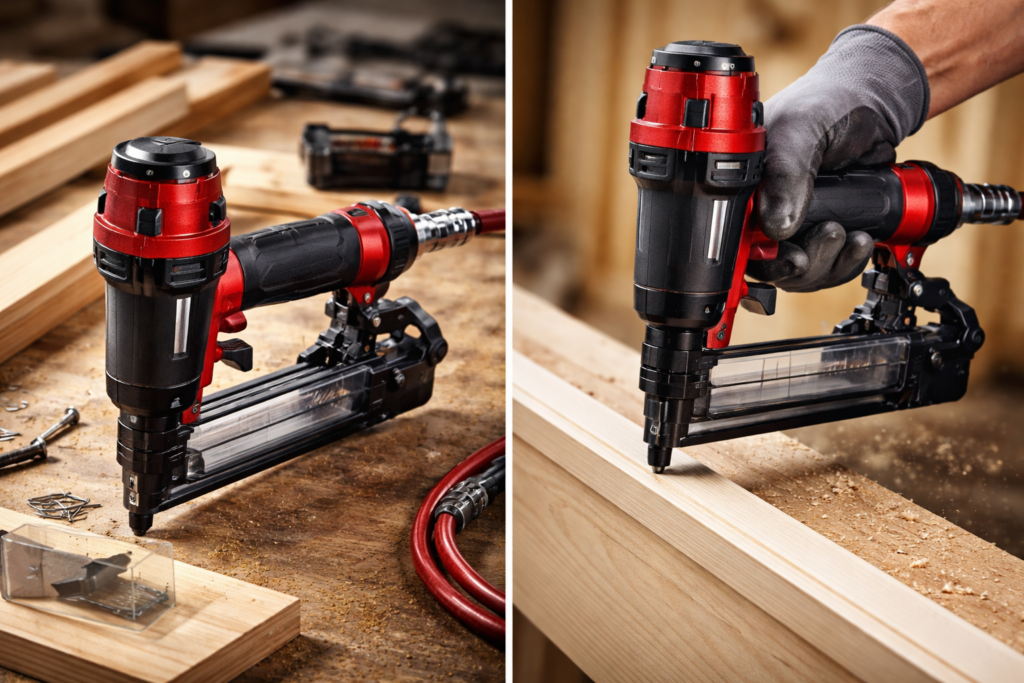
First of all, "What you can do with a nail gun" and "What you can't do"
This is basically what a nail gun is good at.
- Continuous fixation of base materials (framework, stud support, field boards, plywood base, etc.)
- Fixed to have the same depth at the same pitch
- The process requires a large amount of nails, and hammering them by hand takes time and energy.
On the other hand, there is a typical example of ``if you let the nail gun do everything, you are more likely to fail.''
- Fixing the gypsum board body (board screws tend to play the main role)
- “Reinforcement tightening” of joists and large tensioners (structural screws, bolts, and hardware tend to play the main role)
- Fixing the aesthetic appearance of visible features (baseboards, surrounding edges, etc.) (a finishing nailer tends to be required in a separate frame)
The important thing is not that ``a nail gun is a versatile tool,'' but that it is a tool that ``is overwhelmingly effective when used in the process that it is good at.''
Organize the types of nail guns at once: "If you remember this, you won't get lost."
Nailers can be broadly divided into the following types: The reason DIY is so confusing is because things are sold in a jumbled manner.
Roll nailer (coil nailer)
A type where the nails are rolled (connected). It is the main role in preparing the base.
We focus on the categories that are most commonly used in self-renovation projects, such as ``plywood base'', ``field base'', ``framework'', and ``siding base''.
Nailer (compatible with sheet connection)
Depending on the model, it can handle not only rolls but also sheet connecting nails. While the range of support is expanding, it is essential to check the specifications of the nails that can be used (for example, the specifications for NV65HR2 specify that it is compatible with sheet connecting nails of 32 to 50 mm in addition to wire connecting nails of 38 to 65 mm).
Finish nailer (finish nail)
Thin nails used for visible features such as baseboards, edges, and around window frames. Many have small heads and are designed to be difficult to break.
The purpose is different from "coil nailer for base coat". Mixing will ruin the finish.
Pinneyra (even thinner nail)
Pin nails (heads almost invisible) are often used for temporary fixing or as parting material.
However, the holding power depends on the application, so it is dangerous to use pins for everything.
Staple (Tucker type)
A type that staples (U-shaped). Used for fixing insulation materials, temporarily fixing sheets, etc.
In many cases, the main battleground is not ``fixing the structure'' but ``holding it in place.''
90mm class (structural, framing)
This is an area that leans toward carpenter's building methods. Although it is sometimes necessary for DIY, it tends to be heavy and reduces the freedom of working posture.
Whether you choose the first one depends on the amount of work, your physical strength, and the time of day.
Which power method is best for you: “air type,” “rechargeable type,” or “gas type?”
The "strength" of a nail gun is not determined only by the nail gun itself. The experience changes depending on the power method.
Air type (compressor required)
- merit
Strong in continuous work. There are many light aircraft. Easy to drive stably. - Disadvantages
“Surroundings” such as compressor, hoses, couplers, power supply, noise, etc. are required. - suitable person
Type that requires a lot of ground work, will be used for a long time, and will continue to do DIY in the future.
Rechargeable (battery)
- merit
No hose required. Great handling. Work immediately outside. - Disadvantages
The main body tends to become heavy. There are some models that generate heat and uneven driving when repeatedly fired. Battery investment required. - suitable person
``Storage is difficult,'' ``I'm concerned about noise from the neighborhood,'' and ``I often have to do temporary work.''
Gas type (gas cartridge)
- merit
Good handling. Categories often used in the field. - Disadvantages
Consumables (gas) are generated. Performance may decrease in cold conditions. Increased precautions for ventilation and storage. - suitable person
``There are many sites where you cannot pull a hose'' and ``I mainly work outside.''
While it is easy to choose the air type when doing self-renovation, there are also people for whom the rechargeable type is the best choice due to densely populated areas or storage issues. It's OK to divide this depending on your lifestyle.
Choosing nails based on their length alone will result in failure.This is the minimum engineering requirement.
When choosing nails, it is easy to make mistakes if you decide based only on the length. The reason is simple: Nails primarily hold components together with two types of resistance:
- Pull-out resistance (resistance to the force that tries to pull out the nail)
- Shear resistance (resistance to forces that try to shift in the lateral direction)
In DIY, what is more important than ``pulling out'' or ``slippage'' is ``is it sufficient to secure it for the intended purpose?'' and ``will it not loosen over a long period of time?''
Holding power changes depending on the type of nail (shaft)
- Smooth (smooth)
Easy to hit, but easy to miss depending on conditions. - Ring (circular groove)
Tends to be difficult to remove. It is often preferred as a roof base or exterior base. - screw (twist)
It has a tendency to bite into wood, which often contributes to its difficulty in coming out.
The “rate of rotting” changes depending on the material and plating.
Exterior foundations or locations with strong humidity increase the risk of the nails corroding and losing their holding power.
It is important to be aware of the environment when choosing materials such as "galvanized," "molten zinc," and "stainless steel." Be especially careful near the sea, in ventilation areas where condensation is likely to occur, and around bathrooms.
How to think about “nail length” (super practical for beginners)
As a rough guide, consider meeting the following:
- Thickness of the material you want to fasten + length that will firmly bite into the base
- However, if the length is too long, there will be more chance of penetration, cracking, and accidents on the back side.
Since it is important to "align the surfaces" of plywood, fields, and edges, it is realistic to determine the nail length, including adjusting the driving depth (for products such as the NV65HR2, the "usable air pressure range" is specified in the specifications, and operation within that range is emphasized).
This is the main topic: “How to choose a nail gun” 7 steps to avoid getting lost
Step 1: Decide on your construction type
First, the optimal solution will change depending on the type of reader, so we will classify them first.
- Type A “Interior focus”
Mainly gypsum boards, plywood bases, and fixtures. Emphasis on lightness and ease of handling. - Type B "mainly exterior base"
There are many trunk edges, fields, and siding bases. Emphasis on speed and stability. - Type C: “Do it all”
We also do interior, exterior, underlayment, and reinforcement. In the end, the shortest way is to "separate tools by purpose." - Type D “Neighborhood consideration is the top priority”
Noise and work time are constraints. Optimization is required, including process design. - Type E “Difficult to store and move”
The more tools you have, the more difficult it is to continue. Rentals and rechargeables are recommended. - Type F “Short-term intensive (with moving deadline)”
Shorter time is justice. “Never stop” is more important than the initial investment.
Your reader is bound to fall into one of these categories. In the rest of the article, if we proceed with this classification, it will be easier to "make it your own," and it will also be easier to increase the length of stay from an SEO perspective.
Step 2: The first thing to decide is “priority of use”
The biggest minefield when choosing a nail gun is to buy it thinking you can do everything with it.
Decide on your top two usage priorities.
- I want to quickly create a plywood base
- I want to advance in field
- I want to advance the torso
- I want to clean the finishing features.
- I want to speed up the temporary fixing of sheets and insulation materials.
- I want to consider structural (90mm class)
- I want to do it without a hose (emphasis on rechargeable type)
Once the priorities are determined, the model categories can be naturally narrowed down.
Step 3: Decide on model category based on nail length range
At this point, the "mm machine" finally comes out. 65mm is “one of them”.
- Finishing (Finish/Pin): Usually tends to be in the 15-50mm band
- Base (coil/roll): 38-65mm band tends to be the center of attention
- Structure-oriented: 75-90mm band comes into view
For example, NV65HR2 specifies "38-65mm" as its specification.
However, the conclusion of this article is not that 65mm is right, but that the range will change depending on your preferred use.
Step 4: If using an air type, be sure to check the “pressure range”
This is directly connected to safety and longevity.
For example, the instruction manual for the NV65HR2 specifies that it should not be used at temperatures exceeding the operating air pressure range (1.18 to 2.26 MPa).
The instruction manual for MAX's HN-65N4 also includes specific precautions such as safety equipment and working posture.
In DIY, it is easy to increase the pressure because you want to hit it harder, but operating outside the range can lead to malfunctions and dangers. This is a "rule to follow".
Step 5 Select the trigger method with “safety priority”
One of the major causes of nail gun accidents is unintentional firing.
NIOSH's guide indicates that trigger method and training are important risk factors, and that contact (continuous) triggers have a higher risk of injury than sequential (single-shot) triggers (NIOSH Publication 2011-202).
When doing DIY, ``stepladder'', ``roof'', ``narrow space'', and ``fatigue'' tend to overlap, so for beginners it is more realistic to ``prioritize safety triggers'' and ``design the process to avoid work that would make you lose your posture.''
Step 6 Ease of “depth adjustment” is more important than the spec sheet
For plywood bases and edges, the "accuracy of the surface" determines the subsequent processes.
- Floating: surface does not show → finish is wavy → redo
- Sinking: The facing material is crushed → Possibility of negative impact on holding power and finish
Therefore, the more intuitive the depth adjustment is, and the easier it is to test and fine-tune the model, the more valuable it will be for DIY users.
Step 7 Finally, check the “weight and center of gravity” on the actual item
Even in the same category, handling is different. Even if the mass is written in the specifications, the degree of fatigue changes depending on the location of the center of gravity.
If possible, the quickest way is to try it out by renting it or holding it at a store.
``Optimum solution pattern collection'' for various people including models other than 65mm
From here on, I will write ``how to choose'' for each pattern so that readers can easily apply it to their own situations. Product names are summarized in “interchangeable form” at the end.
Pattern A: Focus on interior, prioritizing lightness
- Main process
Plywood base, stud support, fixture base, plaster board (however, screws are the main role of the board) - Nail gun concept
If you are choosing a roll nailer for foundation work, consider the 50mm to 65mm band.
If there are many finishing features, consider using a finishing nailer separately. - Realistic solution as a set
It's hard to get confused between "base nailer" + "impact (for board screws)".
Pattern B: I want to speed up the process by focusing on the exterior base.
- Main process
Field, edging, siding base - Nail gun concept
Roll nailers with a band of 38 to 65 mm are easy to fit (for example, the specifications for NV65HR2 specify 38 to 65 mm).
However, since the fixation of the ``siding body'' is often specified by the manufacturer, it is safer to assume that ``the main field for nailers is down to the base.''
Pattern C: Do everything (interior, exterior, reinforcement)
- common mistakes
“One nail gun is all it takes” → ruined by plasterboard and reinforcement - Realistic solution
The nail gun is dedicated to the role of "advancing the groundwork",
Leave the plasterboard and reinforcement to ``Bis (impact)''. - Finishing features are a separate article area.
A separate finishing nailer may be required for visible areas.
Pattern D: Neighborhood consideration is the top priority (dense residential area)
In fact, ``designing the working time'' is more effective than choosing a nail gun alone.
Furthermore, although this is a topic for workplaces when it comes to noisy work such as using air tools, documents from the Ministry of Health, Labor and Welfare outline the concept of using 85 dB(A) as a standard and the concept of management and protective equipment to prevent noise disturbances.
The idea is the same when it comes to DIY, and if you do the following, you will have fewer troubles.
- Continuous nailing (a process that makes a lot of noise) should be completed during the day.
- In the morning and evening, we perform quiet processes such as inking, checking the base, and tightening screws.
- Use earplugs/earmuffs to reduce fatigue (fatigue increases mistakes)
Pattern E: No storage, lots of carrying around
- realistic strategy
Even if you own the nail gun itself, you can rent the compressor.
Or send it to a rechargeable one. - Note
When renting, the key points to consider on the day are whether it has a high-pressure port and whether the hose and coupler fit. Please check here in advance.
Pattern F Short-term concentration (there is a deadline)
- Justice is "unstoppable"
If you purchase used equipment at a low price and it breaks down, the construction period will be disrupted. - Recommended strategy
If this is your first time, it is practical to diversify your risk by purchasing a new nail gun and a good quality used or rental compressor.
Basics of buying: Which is better: “New,” “Used,” or “Rental?”
People who want new products
- It's my first time and I'm worried about the safety equipment and adjustments.
- It would be a problem if work stopped (there is a deadline)
- I want to emphasize manufacturer warranties and parts supply.
People who are suitable for second-hand items
- Budget-oriented
- You can check the actual item (you can try it out and check its operation)
- No resistance to maintenance
People who rent is suitable for
- Rarely used, difficult to store
- First, I would like to try out the grip, weight, and hose handling.
- Temporarily requires higher class (90mm etc.)
Checklist for second-hand purchase: “Nail gun” edition
A used car is great if you hit the mark, but it's best not to compromise on safety. You can check here in a short time.
1 Is the safety device normal?
MAX's HN-65N4 instruction manual clearly explains safety devices such as trigger lock devices.
It is best to avoid individuals with questionable safety equipment.
2 Is there any air leakage?
If the device continues to make a "shooing" leaking sound when it is connected and left unattended, there is a high possibility that the pressure is not stable, and the driving is also likely to be unstable.
3. If you can try it out, check for “stability of depth”
- There are a lot of floats
- too involved
- If fired repeatedly, it will suddenly become weaker.
Turn the depth adjustment and see if it changes. Individuals who cannot adjust will be in trouble later.
4 Check the wear around the nose (tip)
If the tip is loose or worn, there will be more misses and wood cracks. The fact that safety glasses are included as accessories for the NV65HR2 reflects the fact that the risk of splashing is real.
Safety precautions: “Because it’s DIY, be careful here.”
A nail gun is convenient, but it only takes a moment when an accident occurs. NIOSH's safety guide shows that while nail guns increase productivity, injuries are common, and triggering methods and training are important.
We will summarize the “minimum” for DIY.
1. When it comes to protective equipment, give top priority to your eyes and ears.
- Safety glasses: connecting piece, wooden piece, bounce prevention
- Earplugs/earmuffs: Reduce fatigue (fatigue can lead to poor judgment)
2. Decide on rules for working posture
In the MAX instruction manual, there are specific warnings such as moving forward on slopes from the bottom to the top, and not moving backwards from the top to the bottom, as there is a risk of tripping.
Since footing is often weak when doing DIY, these ``obvious safety rules'' come into play.
3. Observe the pressure range
The NV65HR2 manual clearly states that it must be used within the operating air pressure range and that exceeding the upper limit is prohibited.
The problem is not solved by increasing the pressure, but rather by adjusting the nail and ground conditions within range.
Practical recommended directions from here
5-minute and 15-minute versions of the same-day check procedure for second-hand buyers
A used nail gun has the best value for money, but if you remove it, it will directly affect safety, the process, and whether you will end up buying it again.
Here, we will break down the steps into "minimum 5 minutes" and "quite safe in 15 minutes" so that you can actually use them in the field.
As a premise, when loading or inspecting nails, follow basic operations such as "locking the trigger and disconnecting the air hose" (MAX, n.d.-b). Be sure to also prioritize the safety precautions in the instruction manual (MAX, n.d.-a).
5 minute version - If you watch this at least, you can reduce the number of "big mistakes"
The purpose is to avoid "dangerous individuals" and "individuals that will stop immediately." First decision whether to buy or not.
1 Instant death check on appearance (30 seconds)
- Cracked housing, missing screws, distorted magazine
- Chips and large play around the tip (nose)
Avoid this level as it can easily lead to accidents and blockages.
2 Safety device/trigger system (60 seconds)
- Is the trigger lock effective? (The trigger lock device is specified in the specifications) (MAX, n.d.-a)
- Is there a behavior that allows you to shoot without pressing the tip?
It is safe to avoid individuals with suspicious characteristics for DIY purposes.
3 Air leak sound (60 seconds)
If possible, make an air connection and listen to see if the "hissing" leak continues without doing anything. Individuals that constantly leak are prone to unstable driving, increased consumption, and increased risk of failure.
4 Check pressure range label/model number (60 seconds)
Check whether the model is normal pressure or high pressure, and what the air pressure range is. For example, HN-65N4(D) is specified as 1.2 to 2.3 MPa (MAX, n.d.-a).
Be wary of individuals that have been used outside the range, as their lifespans are likely to be shortened.
5 Miscellaneous check of operation (90 seconds)
If possible, try one or two dry shots, or a few trial shots.
- Sudden weakening due to continuous firing
- Obviously slow to return
- Loud noise
It is safer to avoid individuals who are strong in this area.
At this point, you can decide whether or not it remains a candidate for purchase.
15 minute version packed to a level that you can buy with confidence
The purpose is to increase the accuracy of "putting it on site and not stopping." Only the individuals that remained as candidates in the 5-minute version were tested.
It's good to be prepared
- Safety glasses (so important that many models include them as accessories) (HiKOKI, n.d.-a)
- Small amounts of tool oil (turbine oil ISO VG32 is often specified)
Example: HN-65N4 is specified as turbine oil Class 2 ISO VG32 (JIS K 2213) (MAX, n.d.-a)
NV65HR2 can also be used.Turbine oil ISO VG32~68 etc. are listed as lubricating oils (HiKOKI, n.d.-c)
Lubrication instructions for turbine oil ISO VG32 can also be found in Makita's pneumatic tool manual (Makita, n.d.-b)
Step 1 Check the moving parts before air connection (2 minutes)
- Does the magazine open and close smoothly?
- Is the nail support (nail holding position) adjustable?
Individuals with poor loading mechanisms tend to get jammed.
Step 2: Check lubrication and “return” improvement (2 minutes)
Some models have instructions to add 2 to 3 drops of specified oil from the air plug side (Makita, n.d.-b).
Used specimens may be dry, so seeing if oil improves their movement is helpful in estimating their condition.
Step 3 Adjust the pressure settings to within specifications (2 minutes)
If it is a high-pressure machine, adjust it within the specifications. For example, NV65HR2 is 1.18 to 2.26 MPa (HiKOKI, n.d.-a), and HN-65N4(D) is 1.2 to 2.3 MPa (MAX, n.d.-a).
The important thing is not ``Can you hit hard with maximum pressure?'' but ``Can you move stably within the range?''
Step 4: Estimate the air leak location (3 minutes)
- Is there any leakage around the main unit (near the head, near the coupler)?
- Be careful if you can feel the wind by touching it.
Constant leakage may cause component deterioration and affect stability.
Step 5 Trial shot (5 minutes)
If possible, use about 10 pieces of wood. The points to look at are as follows.
- Are the depths the same? (Are there no extreme variations in ups and downs?)
- Doesn't the impact become weak even if you fire repeatedly?
- Isn't it easy to get clogged?
- Are the nails going in diagonally too often?
In addition, the manufacturer's safety procedures for loading nails, such as ``trigger lock'' and ``remove the air hose,'' are clearly written (MAX, n.d.-b). It is important to be able to perform this operation smoothly even when checking used items.
Step 6: Finally, verbalize the criteria for “buying/waiting” (1 minute)
These are the recommended criteria.
- see off
"The safety device is questionable" "There is a constant air leak" "It becomes extremely weak after repeated shots" "The area around the nose is damaged" - buy with conditions
"There is a slight astringency, but it can be improved with lubrication" "Leakage is small and tolerable" "Testing is stable" - Buy
``Stable with specified internal pressure'' ``Less clogging'' ``Easy depth adjustment'' ``Smooth operation system''
The most important advice for second-hand buyers: "Check the nail specifications and oil specifications on the spot."
The most painful thing about second-hand products is the pattern of finding out after you buy them that they must be used with specified nails.
The instruction manual clearly states, "Be sure to use the specified nails" (MAX, n.d.-a). There are also specifications for lubricants (MAX, n.d.-a; HiKOKI, n.d.-c).
In other words, when purchasing a second-hand product, your chances of success will increase if you can check the model number → instruction manual → specified nail → specified oil on the spot.
References/Materials (APA 7th edition)
MAX Co., Ltd. (n.d.-a). Instruction manual HN-65N4 (high-voltage coil nailer).
(Based on the text: operating air pressure range, specified nails, safety devices, turbine oil ISO VG32)
MAX Co., Ltd. (n.d.-b). How to use a nailer.
(Based on the text: Safety procedures such as trigger lock and disconnecting the air hose when loading)
HiKOKI. (n.d.-a). High-pressure roll nailer NV65HR2 (product specifications).
(Based on text: compatible nail lengths, accessories, etc.)
HiKOKI. (n.d.-c). NV65HR2 Instruction Manual.
(Text basis: Type of lubricant used, air pressure range used)
Makita Corporation. (n.d.-b). Instruction manual (pneumatic tools: Example with lubrication instructions for turbine oil ISO VG32).
(Based on the text: General caution system for lubrication instructions and prohibition of unspecified oil)
Shigeki Yada. (1991). Improving the pull-out strength of wood nail joints.
(Based on the text: Primary data regarding references to screw nails, etc.)
URL summary (links are collected only here)
MAX Instruction Manual HN-65N4:
https://www.max-ltd.co.jp/support/download/kikouhin/torisetsu/pdf/hn-65n4_torisetsu.pdf

How to use the MAX Nailer:
https://wis.max-ltd.co.jp/kikouhin/nailer-details/use/

HiKOKI NV65HR2 product specifications:
https://www.hikoki-powertools.jp/products/powertools/air/nv65hr2/nv65hr2.html

HiKOKI NV65HR2 instruction manual:
https://www.hikoki-powertools.jp/manual_view_domestic/pdf/C99250202_NV65HR2_311.pdf

Research materials (Yada, 1991):
https://ynu.repo.nii.ac.jp/record/800/files/KJ00004473892.pdf
If you do not fix the product name and write it as a category + representative model example, the article will be less likely to fall apart even if there are price changes.
Summary: “Not limited to 65mm, if you divide by “purpose” first, you won’t fail.”
- The nail gun is the best for "preparing the base." For gypsum boards and reinforcement, screws and hardware tend to play the main role.
- To avoid confusion, choose in the following order: ``Construction type → Application priority → Nail length range → Power method → Safety → Depth adjustment → Weight.''
- Safety is our top priority. The importance of trigger methods and training is also shown in the NIOSH safety guide.
- The concept of noise and protective equipment is also summarized in documents from the Ministry of Health, Labor and Welfare (this is a framework for workplaces, but it can also be used as a reference for DIY).
- Used items will have at least a safety device, air leaks, trial shots, and tip wear. The MAX manual clearly states trigger locks, etc.
If you're wondering "How much renovation or remodeling can I actually do on my own home?" or "Where should I even start?", please visit this page. If you're looking to learn more about specific renovation processes or construction details, don't miss this page as well!
Information on updates to this website will be delivered to you once a month.NewsletterIf you are interested, please register.
Please note that this document is not necessarily accurate, and should be used as reference information only.
See you then!
References/Materials (mentioned in the text in (author, year) format)
Summarize the references to clarify the basis in the text. The URL will only be posted here to avoid copy-pasting accidents.
National Institute for Occupational Safety and Health. (2011). Nail gun safety: A guide for construction contractors (DHHS (NIOSH) Publication No. 2011-202). U.S. Department of Health and Human Services, Centers for Disease Control and Prevention.
URL: https://www.cdc.gov/niosh/docs/2011-202/pdfs/2011-202.pdf

National Institute for Occupational Safety and Health. (2011). Nail gun safety: A guide for construction contractors (web page). Centers for Disease Control and Prevention.
URL: https://www.cdc.gov/niosh/docs/2011-202/default.html

Ministry of Health, Labor and Welfare. (2023). “Guidelines for preventing noise disturbances” explanatory pamphlet (R5.9).
URL: https://jsite.mhlw.go.jp/nagano-roudoukyoku/content/contents/souon_syougai-boushi20230914.pdf

Ministry of Health, Labor and Welfare. (Year unknown). Notifications and materials regarding prevention of noise disturbances (including descriptions of machines or appliances driven by compressed air).
URL: https://www.mhlw.go.jp/content/000798926.pdf

Koki Holdings (HiKOKI). (n.d.). High-pressure roll nailer NV65HR2 (specifications).
URL: https://www.hikoki-powertools.jp/products/powertools/air/nv65hr2/nv65hr2.html

Koki Holdings (HiKOKI). (n.d.). NV65HR2 instruction manual (including cautions regarding the operating air pressure range).
URL: https://www.hikoki-powertools.jp/manual_view_domestic/pdf/C99250202_NV65HR2_311.pdf

MAX Co., Ltd. (MAX). (n.d.). HN-65N4 instruction manual (including notes on trigger lock device and working posture).
URL: https://www.max-ltd.co.jp/support/download/kikouhin/torisetsu/pdf/hn-65n4_torisetsu.pdf English
  Japanese
Leave a Reply
You must be logged in to post a comment.