
Hello everyone, this is DIY Renova.
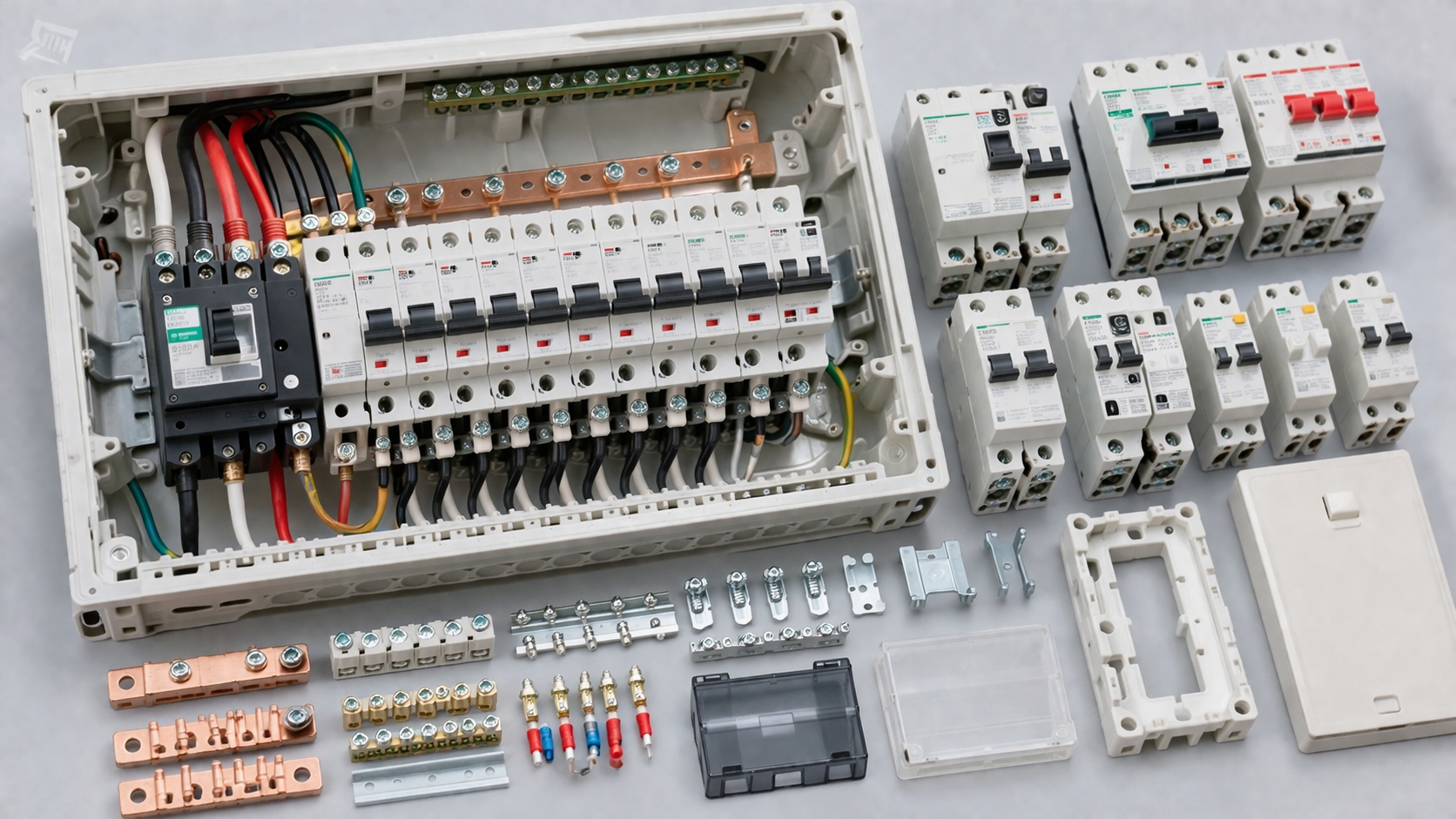
When you start thinking about the electricity in your home, the first thing that comes to mind is the electrical distribution board. Switches and outlets are easy to see, but it's actually the distribution board that organizes the electricity throughout your home, protects safety, and even influences future expansion.
When you are doing self-renovation, you will always come up with questions such as ``I want to add more circuits,'' ``I want to prepare for IH, air conditioning, and EV charging,'' and ``I want to add solar power or storage batteries later.'' At that time, if you view the distribution board as just a ``breaker box,'' it is easy to make a mistake in judgment. In reality, a distribution board is not a "box that separates electricity," but a device that plays a central role in "protection," "interruption," "planning," and "expansion."
In this article, based on the premise of a Japanese home, we will explain the meaning of each term in order to make it easier for DIYers to get confused about what a switchboard is made of. We will also summarize the functions often seen in recent residential distribution boards, such as "HEMS", "limiter space", "seismic breakers", "surge arresters", "EV compatibility", and "solar compatibility". Please note that this article focuses on "understanding the distribution board itself" and does not go into details of the installation procedure. In Japan, expansions, replacements, and connections inside distribution boards require electrician qualifications and legal compliance, so it is recommended that you consider these points separately (Ministry of Economy, Trade and Industry, 2025; Panasonic, n.d.).
If you're wondering "How much renovation or remodeling can I actually do on my own home?" or "Where should I even start?", please visit this page. If you're looking to learn more about specific renovation processes or construction details, don't miss this page as well!
Information on updates to this website will be delivered to you once a month.NewsletterIf you are interested, please register.
Please note that this document is not necessarily accurate, and should be used as reference information only.
So, here you go.
What is a distribution board?
A distribution board is a panel that separates and distributes the electricity drawn into your home to the circuits of each room and each piece of equipment. However, that's not all. The essence of a power distribution board is to "stop when an abnormality occurs," "protect each circuit," and "manage the capacity of the entire house." For example, when too much current flows in a certain circuit, when a leak occurs, or when you want to prevent a fire caused by electricity after an earthquake, the distribution board becomes the starting point for deciding to turn off the electricity (Panasonic, n.d.; TEMPEARL, n.d.).
Roughly speaking for overseas readers, residential distribution boards in Japan are similar to ``consumer units'' or ``load centers,'' but in Japan, they tend to reflect the unique circumstances of Japan, such as single-phase 3-wire 100/200V, earth leakage protection, earthquake countermeasures, and smart meter cooperation (Panasonic, n.d.; ECHONET, n.d.).
Basic parts that make up the distribution board
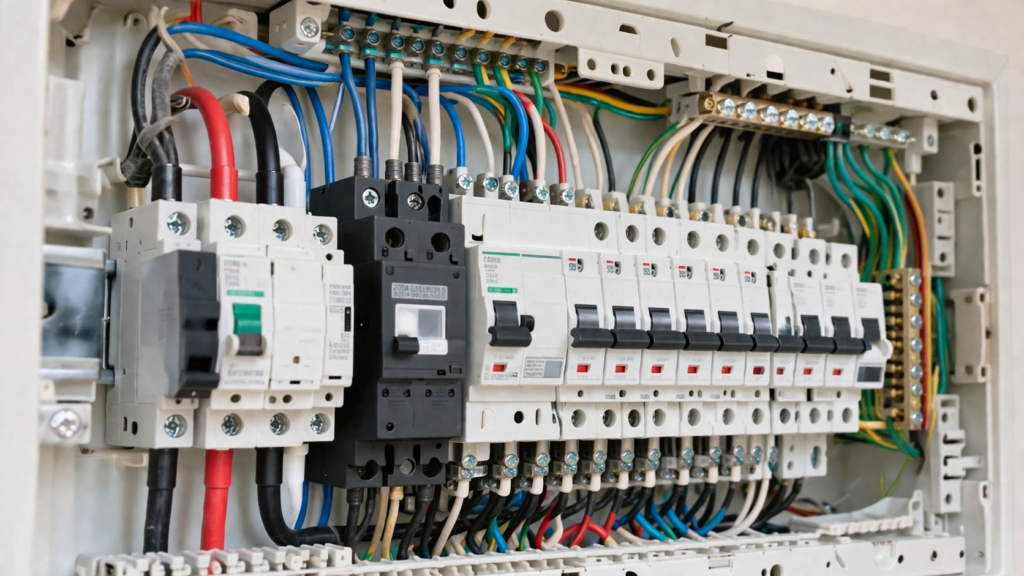
First of all, it will be easier to understand the whole picture if you understand the distribution board in terms of ``what's inside the box.''
box body
The box body is the so-called "outer case." They are available in resin and metal types, and for residential use, thin types with design and ease of construction are on the rise. Recent products are characterized by thin designs that easily fit on walls and sizes that are easy to match with architectural modules (Panasonic, n.d.).
main breaker
The main breaker is the breaker that protects the electrical inlet side of the entire house. This is deeply related to the upper limit of how much you can use at the same time in this house. It has the role of stopping the entire house when an overcurrent flows, and is installed to protect the main line. Panasonic's basic explanation also states that main lines are used to protect main lines (Panasonic, n.d.).
branch breaker
A branch breaker is a small breaker that is separated for each circuit in each room or equipment. We separate and protect circuits according to their purpose, such as lighting circuits, general outlet circuits, air conditioner dedicated circuits, IH dedicated circuits, washroom areas, microwave ovens, toilets, EV charging, etc. The more you have, the easier it will be to divide the equipment into smaller pieces and manage safety, but it's not just about having more, it's important to think about what you want to use as dedicated circuits in the future (Panasonic, n.d.; DIY Renova, 2025).
Earth leakage cutoff function
"Leakage" is when electricity leaks into places where it shouldn't flow. This can occur around water, deteriorated wiring, or deteriorated insulation, leading to the risk of electric shock and fire. For residential distribution boards, it is important to have a configuration that provides earth leakage protection. Even in the context of product classification and regulations, earth leakage circuit breakers are positioned as a core residential safety device (METI, 2025; TEMPEARL, 2021).
Basically, it should be included in all new distribution boards, but it seems that it is also sold separately for replacement in case it breaks!
Bus bar/internal wiring/terminal
Inside the distribution board, conductors and terminal blocks are used to connect each breaker. Recently, in the world of panels and control panels, "push-in" terminals that do not use screws have been attracting attention in order to improve workability and reduce looseness. Not all residential distribution boards are the same, but knowing that ``internal connection methods have also evolved'' will make it easier to see the differences between old and new panels (JECA, 2023).
What is limiter space?
"Limiter space" is a term that often appears when selecting model numbers for old residential distribution boards and some products. This means space for equipment that limits the contracted amperage, so-called "amp breakers" and related equipment. In old houses, the configuration of the panel often changed depending on whether or not this space was available, and even today, product lineups sometimes include ``with limiter space'' and ``without limiter space'' (Panasonic, n.d.).
What's confusing here is that it's not necessarily necessary even in your current home. Since the handling changes depending on the power company's contract method and the progress of smart metering, it is important to check the existing contract method, the power company's equipment configuration, and what to leave behind when updating the panel at the site. In other words, from a DIY perspective, it is practical to understand that "limiter space is a vestige of the past and can be ignored," nor is it "absolutely necessary," but rather as "an item determined by the current contract and disc renewal policy" (Panasonic, n.d.; METI, 2026).
When looking for a switchboard, be sure to check whether it has a limiter space or not on the product page!
Below are the "Yes" and "No" types. Please take a look.
What is HEMS?
HEMS stands for "Home Energy Management System" and is a system that visualizes and controls energy in the home. In Japan, it has become popular as a system that can easily generate value by connecting to smart meters, compatible home appliances, solar power, storage batteries, water heaters, EV chargers, etc. ECHONET explains that HEMS is a system that can "visualize" the energy used at home and "control" HEMS-compatible home appliances and housing equipment (ECHONET, n.d.).
The reason DIYers should know about HEMS is simple: it will change the way they choose switchboards. Even if it's just lights and outlets now, if in a few years there is a possibility of installing solar power, storage batteries, EVs, eco-cutes, or smart home appliances, a distribution board with room for HEMS collaboration will be more advantageous in the long run. Panasonic also introduces a distribution board that supports EV/PHEV circuits that supports visualization in conjunction with HEMS (Panasonic, n.d.).
For example, below is an example of a distribution board containing HEMS.
I have the impression that the price range changes considerably just by including HEMS.
The content of HEMS is not just “visualization”
When you hear HEMS, you tend to get the impression that it's just a monitor that shows your electricity bill, but it's actually much more than that. JEMA's materials explain that by introducing HEMS, in addition to visualizing the flow of electricity, it also enables interlocked control of in-house equipment and increases added value through collaboration with external services (JEMA, 2021).
In other words, the meaning of choosing HEMS-compatible switchboards and peripheral equipment is not only to save energy now, but also to have a gateway to future control. In particular, in the combination of solar power, storage batteries, and EVs, efficiency and economics are likely to be affected by ``when to charge'' and ``what time of day to use'', making it difficult to ignore the compatibility between distribution boards and HEMS (METI, 2025; ECHONET, n.d.).
Smart meter and B route
When talking about HEMS, we cannot avoid talking about "smart meters" and "Route B." Smart meters are electricity meters with communication functions that are becoming increasingly popular in Japan and are becoming important as a data utilization platform for consumers. Route B is the route that passes information from the smart meter to the home-side EMS or HEMS (METI, 2026; Agency for Natural Resources and Energy, 2016).
JEMA's commentary also explains that by using Route B, HEMS can obtain smart meter metering data in real time (JEMA, 2025).
The point of keeping this in mind when DIY is that even if it says "HEMS compatible", it doesn't mean much unless you see how it connects to what. Is it just an app, is it possible to connect to other companies' devices using ECHONET Lite, or can actual measurement data be obtained using Route B? This difference is quite large.
What is ECHONET Lite?
ECHONET Lite is a communication standard that comes up very often when connecting HEMS and equipment in Japan. It has the role of making it easier to connect and control devices from different manufacturers using common specifications. JEMA's materials for ZEH also explain that the government recommends ECHONET Lite as a well-known standard interface for HEMS that make up smart homes (JEMA, 2018).
To put it quite simply, it is a rule that allows machines to speak the same language. If future expandability is important, you will be less likely to regret looking at what standards the entire system on which the panel is mounted is compliant with, rather than just looking at the distribution board itself.
Parts that are increasing in the latest residential distribution boards
From here, we'll take a look at what's included in modern distribution boards. Residential distribution boards have become considerably more multi-functional than the old boxes that only had a main and branch function.
seismic breaker
A seismic breaker is a device that shuts off electricity when it senses shaking above a certain level. Panasonic advises that this function automatically turns off the main breaker in the event of a seismic intensity of 5 or higher to prevent electrical fires after an earthquake. The Ministry of Economy, Trade and Industry is also promoting the use of seismic breakers as a preventive measure against electrical fires during earthquakes (Panasonic, n.d.; METI, 2015).
This is a concept that is quite compatible with people who have experience with Japanese wooden houses, especially old ones. This is because the idea is to consider not only earthquake resistance, but also ``what happens to electricity after shaking.''
Lightning arrester
A lightning arrester is a device that protects home appliances and equipment from lightning surges. There is a type that is installed in residential distribution boards, and Panasonic also promotes it as the ``Kaminari Anshin Ban'' (Panasonic, n.d.).
Electronic controls have become more important in homes than in the past, with electronic controls such as PCs, routers, water heaters, air conditioners, and solar-related equipment increasing. Even in a case where the item was damaged even though it was not struck by lightning, it is possible that it could be affected by a surge, so it is worth remembering that it is the latest part.
Compatible with EV/PHEV charging circuit
This is a distribution board designed for dedicated circuits for electric vehicles and plug-in hybrids. EV charging tends to be a continuous load and is difficult to handle in the same way as a general outlet circuit, so planning will be easier if you assume this on the distribution board from the beginning. Panasonic and Tempearl also have a lineup of residential distribution boards that are compatible with EV/PHEV circuits and have related functions (Panasonic, n.d.; TEMPEARL, n.d.).
Compatible with solar power, storage batteries, and energy creation
In recent years, switchboards have become more commonly configured to support energy creation, such as solar power generation, household fuel cells, and EcoCute. Panasonic's residential distribution board lineup also shows residential distribution panels equipped with breakers for solar power generation systems and household fuel cells (Panasonic, n.d.).
From a DIY perspective, the important question is, ``Even if you don't add sunlight right now, do you have room for future solutions?'' Replacing the panel itself later has a big impact on the wall finish and surrounding wiring, so it makes sense to allow some leeway when making your initial selection.
Power consumption monitor/communication unit cooperation
Some HEMS-compatible panels work with communication units and monitors to visualize and control power consumption. This is not just a convenient feature, but the foundation of future smart homes. In addition to visualization, control and service coordination are also organized as the value of HEMS in JEMA and ECHONET materials (JEMA, 2021; ECHONET, n.d.).
If you try to use hardware, it's quite expensive...
There are some systems that allow you to view on a smartphone or tablet, so it might be a good idea to see if you can do it on that first.
The minimum things you should check when looking at the switchboard now
When studying about switchboards, the points that beginners should look at first are surprisingly narrow.
- The first is "main capacity." It depends on how much it can be used throughout the house.
- The second is the number of branch circuits. We consider not only the current situation but also the equipment that will require dedicated circuits in the future.
- The third is "presence or absence of limiter space". It may be necessary to align with existing contracts.
- The fourth consideration is the presence or absence of "earth leakage protection, earthquake protection, and lightning protection." There is a difference in safety thinking.
- The fifth point is "room for HEMS, solar power, and EVs." It will come into effect later.
- The sixth factor is the depth of the manufacturer's lineup. Whether it is easy to expand or change in the future within the same series is a subtle but important question (Panasonic, n.d.; TEMPEARL, n.d.).
The whole process of choosing a distribution board is How to choose a 60A distribution board and recommended manufacturers and products Please also take a look.
The entire future electricity plan is Things to consider and be careful about when making an electrical plan
If you want to consider solar and DIY qualifications,Home DIY that you can do with a Class 2 electrician qualification or Electrical work to be done by an electrician and how to request it Please also see.
Summary
A distribution board is a piece of equipment that can't be understood simply as a box containing a "main breaker" and a "branch breaker." In reality, it is an "electrical control tower" that affects the safety of the entire house, capacity design, expandability, and even the future of smart homes.
Particularly recently, concepts surrounding distribution boards have been rapidly expanding, such as "HEMS," "smart meter B route," "ECHONET Lite," "earthquake breakers," "surge arresters," "EV compatible," and "energy creation compatible." That's why it's best for people who are thinking about building a home by DIY to not think of a power distribution board as an old, plain box.
In fact, if you understand this, the electrical plan for the entire house will become much clearer!
If you're wondering "How much renovation or remodeling can I actually do on my own home?" or "Where should I even start?", please visit this page. If you're looking to learn more about specific renovation processes or construction details, don't miss this page as well!
Information on updates to this website will be delivered to you once a month.NewsletterIf you are interested, please register.
Please note that this document is not necessarily accurate, and should be used as reference information only.
So, here you go.
References/Reference materials
- ECHONET “What is HEMS?”
- ECHONET “What is HEMS?”
- JEMA “The role of HEMS in IoT housing”
- JEMA “About the use of HEMS at ZEH”
- JEMA “A route, B route, C route, IoT route”
- Agency for Natural Resources and Energy “EMS/Aggregation Controller Smart Meter B Route Guidelines” 2026 revised edition
- Agency for Natural Resources and Energy White Paper “Towards effective utilization of energy resources on the consumer side”
- Panasonic "Breaker/Distribution Board: Limiter"
- Panasonic “Residential distribution board”
- Panasonic "Standard General (with limiter space)"
- Panasonic "Seismic breaker"
- TEMPEARL “Residential distribution board”
- Ministry of Economy, Trade and Industry “Awareness raising awareness of seismic breakers”
- Ministry of Economy, Trade and Industry “Electrical Appliance and Material Safety Act Legal Business Implementation Manual Ver. 6.0.0”
- JECA “Trends in distribution boards and control panels” publication information
- DIY Renova internal link
 English
  Japanese
Leave a Reply
You must be logged in to post a comment.