
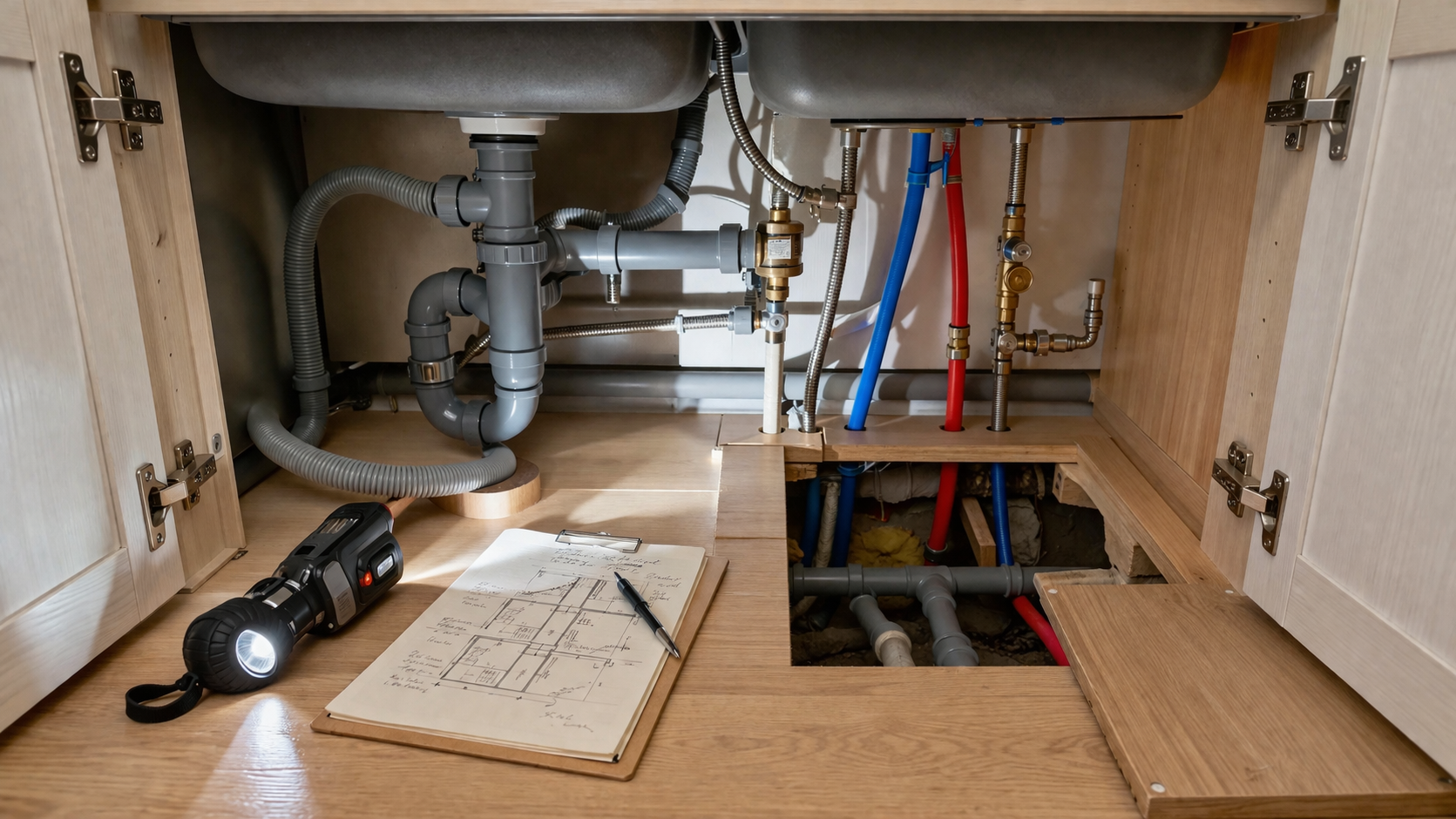
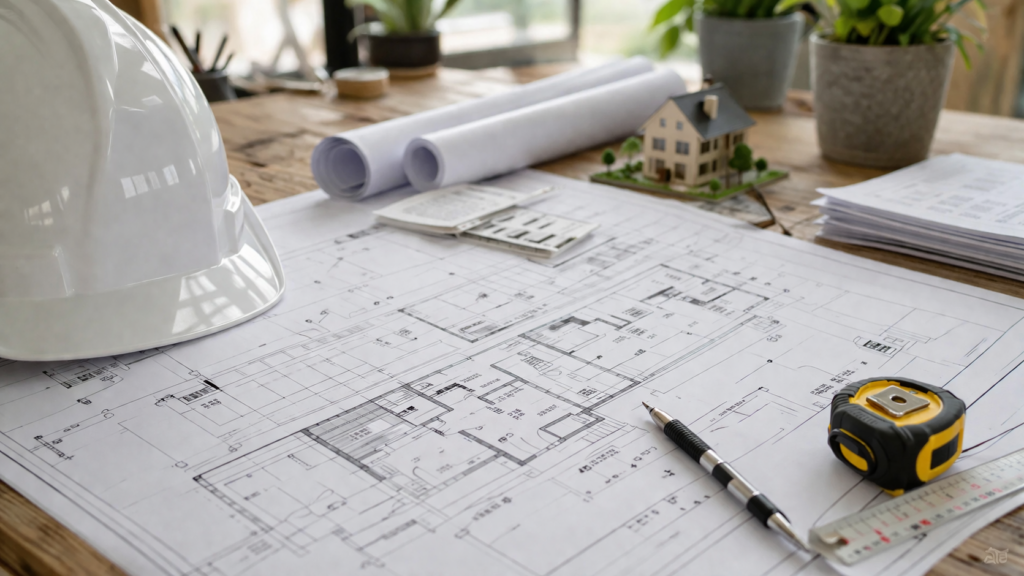
Hello. DIY Renova.
When you start thinking about self-renovation, one of the questions you run into surprisingly early on is, ``What is the current condition of my water supply?'' Even if you want to change the location of your kitchen, sink, toilet, or bath, your plans will go stale if you don't know the routes of existing water pipes and drain pipes. As a result, after demolition, you may wonder, ``Oh, there was a pipe going here?'' or the estimate tends to be higher than expected. In Japan, there is a legal framework for construction of water supply equipment, and local governments and water supply companies often have certain drawings and ledgers, so it is quite realistic to be able to learn about the water pipes in your home before remodeling (Water Supply Law, n.d.; Ministry of Health, Labor and Welfare, n.d.).
In this article, we will focus on the theme of ``Learning about water piping,'' assuming a Japanese wooden house, and will explain what to check and in what order before remodeling, so that even beginners will not get confused. In addition, in Japan, the operating entities and the scope of disclosure vary considerably depending on the region, so it cannot be said that ``everywhere in the country you can understand everything in the same way''. Instead, if you know ``where to go and how much to understand,'' you can move forward with a high probability (Chiba Prefectural Enterprise Bureau, 2025; Yokohama City Waterworks Bureau, 2025; Kanagawa Prefectural Enterprise Bureau, n.d.).
If you want to carry out self-renovation in Japan, the first thing you should know is the obvious but serious fact that the more invisible the plumbing, the greater the cost of redoing it. Even if you can redo the wallpaper and flooring, the more you touch the plumbing under the floor or inside the walls, the more cost and effort it will take. DIY Renova also organizes the timing when the floor is open as the "golden time" to proceed with the design and confirmation of water, gas, and outdoor plumbing. Even when considering the entire self-renovation process, figuring out the plumbing is something that should be done fairly early in the process (DIY Renova, 2024; DIY Renova, 2025a). If you want to organize the entire process first,In what order should I renovate everything? [Self-renovation]It will be easier to understand the flow if you read them together.
If you're wondering "How much renovation or remodeling can I actually do on my own home?" or "Where should I even start?", please visit this page. If you're looking to learn more about specific renovation processes or construction details, don't miss this page as well!
Information on updates to this website will be delivered to you once a month.NewsletterIf you are interested, please register.
Please note that this document is not necessarily accurate, and should be used as reference information only.
So, here you go.
In the first place, what does it mean to “know about water piping”?
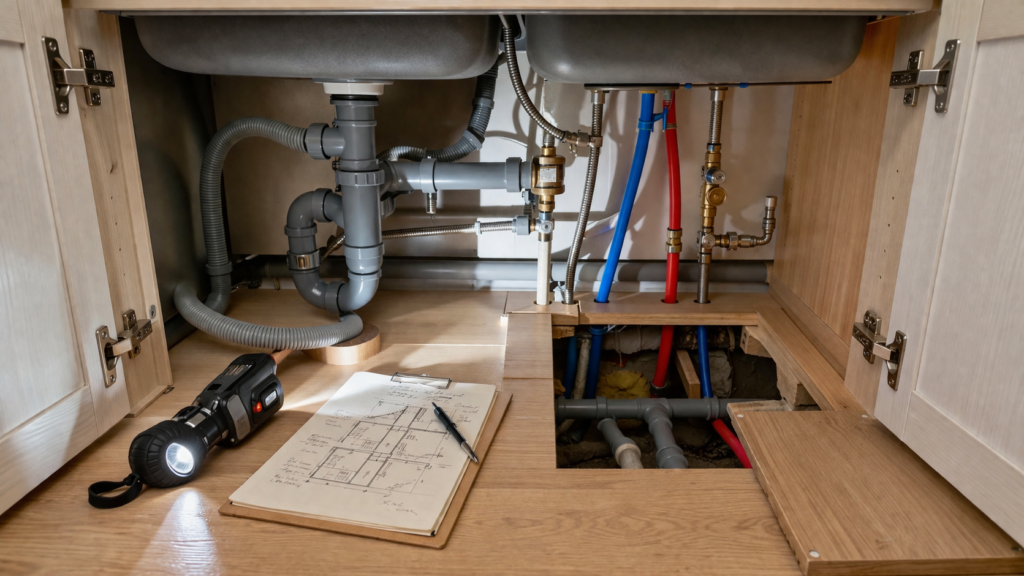
"Knowing water piping" here does not just mean knowing the location of the faucet. This means understanding at least the following four things:
The first question is "where on the road is the main pipe?" A main is a water company's water pipe that runs along the road.
The second question is "where is it drawn into the site?" In other words, it is the location of the service pipe that enters your home from the main pipe.
The third is "where is the meter and what caliber is it?" The caliber is a guideline for the thickness of the pipe, and it comes in handy when considering expansions or equipment changes.
The fourth question is "Where does it branch out within your home?" Once you understand this, you can see how difficult it will be to relocate a kitchen or add a washroom (Chiba Prefectural Enterprise Bureau, 2025).
For the uninitiated, a ``main pipe'' is the trunk line of a road, a ``service pipe'' is a branch line that enters a house, a ``meter'' is a meter that measures the amount of water used, and ``internal plumbing'' is a branch line inside the house. From an engineering perspective, it is very important to separate what ends on the operator's side and where ends on the owner's side. This is because most information that is likely to be disclosed is on the road side or mains side, and the closer it is to personal information, the narrower the scope of disclosure becomes (Osaka City Waterworks Bureau, 2025; Kanagawa Prefectural Enterprise Agency, n.d.).
The reason why local governments often have something in Japan
You may be wondering, "Is it really convenient to have a water supply plan for your home?" However, in Japan, there is an institutional framework for construction of water supply equipment, such as drilling holes in water pipes and connecting water supply pipes, and each water service provider operates a system of designated water supply equipment construction companies. The Ministry of Health, Labor and Welfare's system materials also explain that in order to run water supply pipes to newly built homes, etc., it is necessary to drill holes in the water pipes owned by the water supply company, and that improper work can lead to water leaks and water quality abnormalities. As a result, documents such as application, approval, and construction documents tend to remain in the structure (Ministry of Health, Labor and Welfare, n.d.).
However, this point is important, so I emphasize it. In Japan, it is true that ``local governments often have something in their possession,'' but ``all the pipes in the house are still in good condition'' is a different matter. In fact, the Chiba Prefecture Enterprise Bureau only publishes water pipe management charts on the Internet, and since drawings of water supply equipment contain a lot of personal information, they have advised that they can only be made available at the counter to the owner or his/her agent. Some local governments clearly state that drawings of existing drainage facilities in residential areas may only be available to the owner, and may not be saved (Chiba Prefectural Enterprise Bureau, 2025).
What is different depending on the region?
There are considerable regional differences. There are three main differences: ``operating entity,'' ``disclosure method,'' and ``viewable range.'' For example, at Chiba Prefectural Waterworks, you can check the location and diameter of distribution pipes, the location and diameter of water supply pipes, the location of water meters, etc. using the pipe information viewing system. On the other hand, drawings of water supply equipment etc. are not published on the Internet. In Yokohama City, there is a system for viewing branch ledgers, public pipe ledgers, private pipe ledgers, water piping floor plans, and issuing copies of completed water supply equipment construction drawings, etc., but this system is mainly targeted at owners or those who have been delegated. In Osaka City, information on some water supply equipment that is not included in the public water supply management map is available only to users, owners, and agents (Chiba Prefectural Enterprise Bureau, 2025; Yokohama City Waterworks Bureau, 2025; Osaka City Waterworks Bureau, 2025).
In other words, although the core methods are similar across the country, the actual entry points differ from region to region. In one municipality, you can check the information online, in another municipality, you will need to fill out a survey form at the counter, and in yet another municipality, you will need to apply in advance and register your ID. Therefore, the shortest route is to first find out if it is available in your area (Yokohama City Waterworks Bureau, 2025;).
Specific steps to understand water piping before remodeling
Step 1: First, check "which business operator's area"
The first step is to find out which water provider's service area your home address is in. This is subtle but the most important. In areas like Chiba Prefecture, where prefectural and municipal water systems coexist, if you leave out the contact information, the conversation will not proceed. The Chiba Prefectural Enterprise Bureau also advises you to consult your local water supply office (Chiba Prefectural Enterprise Bureau, 2026).
The way to find out is simple: search for ``water supply area'', ``water supply and sewage bureau'', and ``water company'' on the local government website. If you don't know, just call and ask, ``Which water supply zone is your home address in?'' You don't have to use technical terminology here.
Step 2: View publicly available pipeline information first
Once you know the operator, the next step is to check the publicly available pipeline information. There's more to learn here than you might imagine. In some cases, such as Chiba Prefectural Waterworks, you can see the distribution pipes, water supply pipes, and meter locations, and in other cases, you can view them at the pipe network map counter.
The purpose of this stage is not to suddenly go and get a detailed diagram of the inside of the house. Let's attack from the outside first. It is important to get a general idea of where the main pipe is on the front road, which direction of the site it is likely to be drawn from, and whether the meter is next to the road or next to the building. This alone will give you a good idea of whether your plan to move your kitchen or bathroom to a faraway location is realistic.
Step 3: Inquire about “water supply equipment drawings”, “completed drawings”, and “ledger” as the owner
If the published drawings are insufficient, we will contact you as the owner for additional materials. Although the names vary depending on the local government, the candidates you should ask about are generally the same.
- Water supply equipment drawing
- Diagram of completed water supply equipment construction
- しゅん工図書
- water supply ledger
- Service pipe information
This is around here (Yokohama City Waterworks Bureau, 2025; Osaka City Waterworks Bureau, 2025; Kanagawa Prefectural Enterprise Agency, n.d.).
Basically, you go to a water supply-related municipal facility and pay a fee to view or receive the materials directly. Please check the information of your relevant local government regarding this.
If there is no information on the local government website and you would like to first inquire about the situation by telephone, etc., you can use the following expressions to make inquiries:
``To confirm before remodeling my home, as the owner, I would like to confirm whether there are drawings of the water supply system, completed construction drawings, and documents that show the location of the water supply.''
This is enough to convey the message. In the case of a representative, a power of attorney may be required (Chiba Prefectural Enterprise Bureau, 2025; ).
Step 4: Check sewerage and drainage at the same time
When we say "water piping" here, we tend to think of only water supply, but drainage can be a stronger constraint when it comes to renovation projects. Drainage is basically based on natural flow, so the plan will not work unless there is a sufficient slope. For beginners, drainage works by ``tilting the water little by little so that it flows down by itself''. Therefore, even if water supply can be extended far, drainage may not be so easy. If you have a public sewer ledger or a drawing of the drainage facilities in your property, you should definitely check them at the same time.
DIY Renova also states that it is rational to design and confirm infrastructure work all at once in the "advance phase." If you only focus on water supply and postpone drainage, you may need to adjust the location of the sink or kitchen later. As a related internal link, if you think about the timing of outsourcing piping Things to be careful about when and when requesting infrastructure work through DIY renovation is also helpful.
Step 5 Be sure to check the drawings and the site
This may be the most important point. The drawings you get are simply not true. The Kanagawa Prefectural Enterprise Agency also advises that the provided materials are reference maps and may differ from the current situation, so be sure to conduct on-site confirmation and test digging. In other words, drawings are not "answers" but "strong hints" (Kanagawa Prefectural Enterprise Agency, n.d.).
The key points to look for in on-site verification are simple.
- Meter box position
- Location of outdoor faucets and water heaters
- Arrangement of kitchen, sink, toilet, and bathroom
- Types and orientation of pipes visible from the underfloor inspection port
- Traces of past additions and renovations
Check this area by comparing the drawings and notes. It is not uncommon for older houses to be renovated midway through and differ from the drawings.
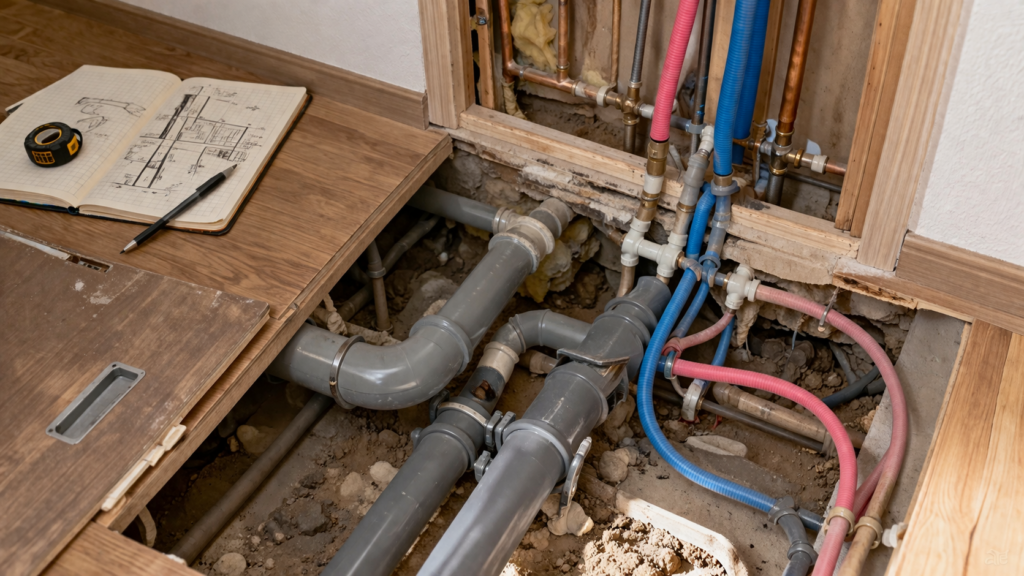
Points that can easily go wrong when understanding residential plumbing
One of the most common mistakes is to think that if you have the local government's drawings, you can understand everything. In reality, even if you know the location of the main road and the lead-in location of the road, you may not know the branches or update history within your home. In particular, for older homes, homes with a history of additions, and homes where only some of the equipment has been replaced, there is a high possibility that the paper records and the actual location may be out of sync (Chiba Prefectural Enterprise Bureau, 2025;).
The second thing to think about is that all you need to know is the water supply. In practice, constraints on drainage routes may stop plans. Even if you move the kitchen a few meters, the success or failure of the project will depend on the location of the flooring, beams, foundations, and external walls, so it is safe to consider water supply and drainage as a set.
In particular, drainage, unlike waterworks, is not currently a task that must be carried out by a municipally-approved water utility. For this reason, there may be cases where there are no materials left.
The third reason is that the timing of inquiries is too late. If you repair the walls and floors first and then review the plumbing, you will have to tear them down and put them back together. The Ministry of Land, Infrastructure, Transport and Tourism has laid out the importance of basic inspections, mainly visual inspections, in order to understand the current condition of existing housing, and the idea of understanding the condition before remodeling is itself very rational (Ministry of Land, Infrastructure, Transport and Tourism, 2013).
How much should I do myself and where should I ask a professional?
In this theme, I want to focus on "knowing about piping," so I won't go into details about the construction itself. However, in Japan, there is a legal framework for construction of water supply systems, so it is safe to separate the investigation and record confirmation from the actual construction decisions. All you have to do is order the materials, observe the current situation, and organize the plan. When it comes to connections, water supply, and legal procedures, it is essential to check with the local designated contractor or water company (Water Supply Law, n.d.; Ministry of Health, Labor and Welfare, n.d.; DIY Renova, 2025b). As a related internal link, those who want to organize their DIY limit lines How much can you save by renovating your home yourself? are also compatible.
What to bring and prepare before going to the counter
When going to a counter or on-site inspection, small items for organizing information may be more useful than flashy tools.
クリアファイル、A4の方眼メモ、油性ペン、スマホ、モバイルバッテリー、3〜5mのメジャーです。図面と現況を照らし合わせるとき、寸法の当たりを取れるだけで理解が一気に進みます。
Rather than rushing to buy expensive tools, it is less likely to make a mistake if you first get tools that are easy to record.
Notes specific to Japan that I would like to convey to overseas readers
In some countries overseas, there are cultures and systems that allow a considerable degree of DIY plumbing work, but in Japan, the system for plumbing work is relatively strict. Therefore, it is dangerous to apply information from overseas directly. When self-renovating a house in Japan, it is safe to ``first collect information from local governments and water supply companies'', ``check local rules'', and ``contact designated contractors or qualified personnel for necessary construction work'' (Ministry of Health, Labor and Welfare, n.d.; Chiba Prefectural Enterprise Bureau, 2025).
This is not too conservative, but it is also a reasonable step to prevent water leaks and re-construction later. This is because piping is invisible, so when a problem surfaces, it can cause a lot of damage. The idea of placing importance on understanding the current condition of housing and on inspections is also consistent with this trend of ``early identifying invisible deterioration and defects'' (Ministry of Land, Infrastructure, Transport and Tourism, 2013; Tada, 2021).
Summary
If you're wondering "How much renovation or remodeling can I actually do on my own home?" or "Where should I even start?", please visit this page. If you're looking to learn more about specific renovation processes or construction details, don't miss this page as well!
Information on updates to this website will be delivered to you once a month.NewsletterIf you are interested, please register.
Please note that this document is not necessarily accurate, and should be used as reference information only.
It's not only possible to know about the plumbing in your home before renovations, but there's a high probability that you'll know about some of it. However, there are large regional differences in what and how much information can be obtained, and in some cases the information is only available on public drawings, while in other cases as an owner you may be able to request water supply system drawings and drainage equipment drawings. The important thing is not to expect a perfect single-sheet image from the beginning.
- Check water supply area
- View published main/drawing information
- Ask for additional materials as an owner
- Also check the drainage
- Check with the local
In this order, the resolution of information is gradually increased. Although this may seem like a long shot, it is ultimately the method with the least chance of failure (Chiba Prefecture Enterprise Bureau, 2025; Yokohama City Waterworks Bureau, 2025).
The more you know about self-renovation before you break it, the stronger it is. Especially when it comes to water piping, simply increasing your knowledge will make a difference in the accuracy of your plans, conversations with contractors, and how satisfied you are with estimates. Although it is not flashy, this confirmation work is a very ``effective'' preparation. First, open the page for your local water company and search for the following four words: "pipeline information", "water supply equipment drawings", "water supply ledger", and "sewerage ledger". From there, the preparations for the renovation have already begun.
References/reference pages
- DIY Renova. (2024, November 2). In what order should I renovate everything? [Self-renovation]
- DIY Renova. (2025a, April 14). DIY water-related maintenance/repairs and scope of your home "Self-renovation"
- DIY Renova. (2025b, September 1). Things to be careful about when and when requesting infrastructure work through DIY renovation
- DIY Renova. (2025c, October 11). To what extent can you save money by renovating your home yourself? (Assuming a wooden house in Japan)
- Osaka City Waterworks Bureau. (2025, July 25). Information on the Waterworks Bureau drawing viewing corner
- Kanagawa Prefectural Enterprise Agency. (n.d.). For customers who want to check the buried status of water pipes
- Ministry of Land, Infrastructure, Transport and Tourism. (2013). Existing home inspection guidelines
- Ministry of Land, Infrastructure, Transport and Tourism. (n.d.). Inspection (inspection/survey of existing houses)
- Ministry of Health, Labor and Welfare. (n.d.). About the designated water supply equipment construction business operator system
- Water Law. (n.d.). e-Gov Law Search. https://laws.e-gov.go.jp/law/332AC0000000177
- Tada, Yutaka. (2021). Organizing the survey targets for performance improvement inspections for wooden detached houses
- Chiba Prefectural Enterprise Bureau. (2025, December 12). Pipeline information viewing system Q&A
- Chiba Prefectural Enterprise Bureau. (2026, January 15). About viewing water pipeline information
- Yokohama City Waterworks Bureau. (2025). Regarding provision of pipeline information
 English
  Japanese
Leave a Reply
You must be logged in to post a comment.