
Hello everyone, this is DIY Renova.
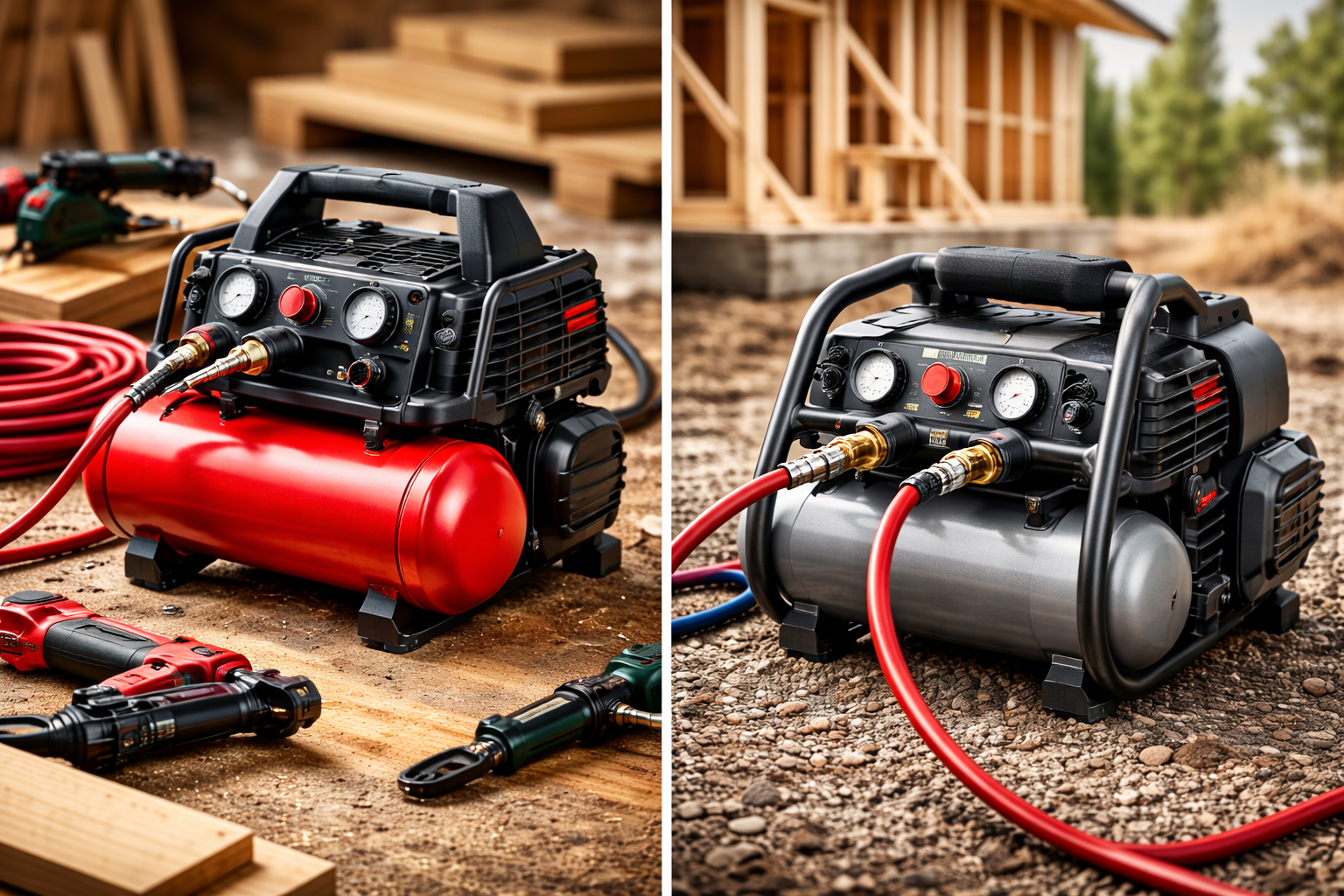
This is a ``compressor version'' that is intended to be read in conjunction with an article about nail guns. In conclusion, the four things you tend to regret when doing a DIY renovation are: ``Even though the pressure is sufficient, the discharge volume is not enough'', ``I prioritize quietness too much and nail driving stops'', ``the power supply (breaker) trips'', and ``I don't drain the water and it rusts and shortens its life''. Just by crushing this, the stress you experience will be drastically reduced.
If you're wondering "How much renovation or remodeling can I actually do on my own home?" or "Where should I even start?", please visit this page. If you're looking to learn more about specific renovation processes or construction details, don't miss this page as well!
Information on updates to this website will be delivered to you once a month.NewsletterIf you are interested, please register.
Please note that this document is not necessarily accurate, and should be used as reference information only.
So, here you go.
First of all, "vacuum pump" and "compressor" are different things.
"Makita Rechargeable Vacuum Pump" etc. are machines used for "vacuuming (sucking out internal air and moisture)" air conditioning piping. What you need for nail driving is an air compressor that creates and pushes out compressed air. You cannot drive nails with a vacuum pump because the purpose is exactly the opposite. This is a point where DIYers tend to get confused.
“DIY comfort level” determined by air compressor selection: 4 axes
1) Normal pressure or high pressure depends on the nail gun you use.
- Normal pressure: Approximately 0.8 to 1.0 MPa (display varies depending on model)
- High pressure: Compatible with extraction pressures around 2.3 to 2.5 MPa (commonly used by carpenters on site)
What is important is that the ``compressor side outlet'' and ``corresponding pressure on the tool side (nail gun)'' match. Even if you connect a high-pressure nail gun to a normal-pressure compressor, the performance will not be improved, and it will be dangerous (choosing the right tool is your top priority).
It is true that many people consider high pressure when looking at everything from ``a house's gypsum board, plywood base, joists/strength reinforcement, rafters/sheathing, sillage, and siding base.'' The instruction manual clearly states that MAX's high-pressure machine operates within the tank internal pressure display range of 0.0 to 4.4MPa.
In addition, Makita's AC500XL series has a pressure adjustment range of high pressure 0 to 2.45 MPa in addition to general 0 to 0.88 MPa as a main function.
2) “Discharge amount (L/min)” is the heart of the main unit. “Stopping” in nail driving occurs here.
Although it is often overlooked in catalogs, the cause of clogging during nail driving is often due to the "discharge rate" rather than the tank capacity.
- Faster nailing, longer nails, and harder wood “eat up more air”
- If the discharge rate is insufficient, the pressure will drop and the nail will not go in properly → re-hammer → the material will crack → it will be frustrating.
For example, the instruction manual for the Makita AC500XL series states that the discharge air volume is 83L/min at 2.5MPa and 98L/min at 0.69MPa.
Be sure to check this ``at what pressure is the discharge amount?'' For high pressure operation, "discharge amount on the high pressure side" is effective.
3) Tank capacity is a ``buffer that absorbs waves.'' The larger the tank capacity, the easier it is for continuous work.
The tank temporarily covers the lack of discharge volume.
- For light indoor work (slight strokes and alignment), even a smaller size will work.
- The larger size is more comfortable if you want to hit repeatedly at a good tempo, such as on exterior wall bases and fields.
For example, the Makita AC500XL has a tank capacity of 11L, and the AC500XG series has a tank capacity of 16L.
However, "a large tank will not solve everything", and if the discharge volume is weak, you will end up running out of breath.
4) Quiet, weight, size, “handling” and “neighborhood consideration”
If you have a DIY home, you may be concerned about the eyes of your neighbors at night, in an apartment complex, or elsewhere. Models that have a silent mode are certainly convenient, but the instruction manual also states that in cold winter environments, the model may enter "warm-up mode" when starting up.
If you are buying with quietness as your priority, it is safer to consider whether it will stop driving nails when in silent mode (=discharge volume and tank allowance).
Many people are having problems with the power supply due to the 100V/15A/extension cord.
A common occurrence at a DIY site: The breaker trips.
The Makita AC500XL series is specified as having a current of 15A.
In the MAX instruction manual, when using an extension cord, it is instructed to ``pull it all out'' with a thickness of 2.0mm2 or more and a length of 30m or less.
Practical points that can be said from here:
- Even with a 100V machine, you can use it as if it were a "dedicated circuit" (it tends to fail if there is a microwave oven, etc. on the same circuit).
- Pull out the drum reel completely (it tends to generate heat if it is wound)
- Keep the extension cord in its thickness and length (if it is thin, the voltage will drop, the capacity will drop, it will overheat, and it will stop)
"Draining" is directly linked to longevity and safety. Don't cut corners here.
With compressed air, moisture in the air condenses and "water collects in the tank." If left unattended, it will easily rust, and water will circulate in the air line, negatively impacting the tool side.
- Makita instruction manual: Before maintenance and inspection, there is an instruction to ``fully open the drain cock to remove all compressed air from the tank.''
- Furthermore, it is written that before long-term storage, "open the drain cock fully and run the machine for at least 5 minutes" (with the intention of adjusting the internal condition).
- Even on Hitachi's maintenance page, there is a warning to ``open gradually'' when draining the drain, as it may spray out forcefully.
From a global perspective, standards clearly state that air tanks (air receivers) must have a drain to remove water and oil (US OSHA regulations).
Similarly, there is safety information that recommends "draining water every day" unless the drain is automatic.
If you want to reduce it to DIY site rules:
- At the end of the day's work, open the drain and drain the water.
- However, it may come out forcefully, so keep away from your face and hands and slowly release it.
- It is especially easy to accumulate during humid seasons (rainy season) and on days with large temperature differences.
Recommended ideas for each purpose: “Which type are you?”
From here on, we will organize the items by pattern, assuming a wide range of items from pillar nails to square timbers. The correct answer depends on the tool and amount of work.
Pattern A Indoor main: Gypsum board, base, plywood
- Nail driving is "light" (less continuous nailing, more positioning)
- I want quiet noise with consideration for the neighborhood.
- Emphasis on storage and portability
In this case, there are cases where normal pressure, silent oil-less systems (10L to 30L) will work. "Quiet and small" as mentioned in the product candidates above, are easy to use at home. However, there is a possibility that it will "stop when nailed", so if the amount of work increases, consider moving to higher pressure.
Pattern B: Also touch on the structure: joists/large reinforcement, rafters/fields, and even the rim.
- Nailing is heavy and tends to be repeated
- Longer nails, harder wood, more work
- In the future, I would like to do everything from exterior foundation to on-site work.
High pressure is likely to be a candidate here. For Makita AC500XL series, the adjustment range and discharge amount of high pressure 2.45MPa are specified in the instruction manual.
For the MAX series, the behavior when the temperature rises and it is difficult to restart (it may make strange noises, but it is not abnormal) is written in the instruction manual, and the ``happen'' of on-site operation is incorporated.
Pattern C: I want to start cheap with a used item.
Although used items are more cost-effective, they can be hit or miss. Avoid the least amount of landmines by using the later check steps.
Things to check when buying a new product: ``Just look at the catalog here.''
At a minimum, if you keep the following 7 points in mind, you will reduce your chances of failure.
- "Whether the tool is normal pressure or high pressure" matches
- Sufficient “discharge amount” (especially for high pressure operation)
- The "tank capacity" is appropriate for the work tempo (if it is too small, it will rotate frequently)
- Look at the "current (A)" and make a power supply plan (15A class is common)
- Observe extension cord conditions (instructions such as thickness 2.0mm2, 30m or less)
- Is the structure easy to drain (draining water) (assuming you do it every time)?
- Is the manufacturer strong in repair and parts supply (reliable long-term operation)?
``Same-day check procedure'' for second-hand buyers 5-minute and 15-minute versions
you told me here
"Restart behavior" "Abnormal noise" "Rise in pressure" "Air leak" "Drain water/rust"
We will create a practical template based on.
5 minute version: Lowest point to buy/quit
- Appearance: Is there any "strong rust" or dents around the tank bottom, welds, and drain (the bottom is the most dangerous)?
- Power ON: Is there any abnormal lamp or error display? (Digital display makes a difference here)
- Pressure rise: Does it “rise normally” from around 0 to the maximum pressure (be careful if it is extremely slow)
- Air leakage: Is there a "hissing" leakage sound that continues after the operation is stopped?
- Drain: Open it a little and see if a large amount of water/rust-colored water comes out (some water is normal, but if there's a lot of rust liquid, it's scary). Drain may spout out with force, so do it gradually.
15 minute version: A push to “buy with confidence”
In addition to the 5 minute version:
- Restart behavior: Isn't it unnaturally long after it stops until it starts running again? The instruction manual also states that when the temperature is high, the restart operation may make abnormal noises.
- Quality of abnormal noise: Metal rubbing, impact sound, strong vibration, etc. are out of the question (avoid abnormal noises that are difficult to explain)
- Safety valve: Blowing (activating) on its own is listed as an abnormality.
- Automatic recovery trap: There are specifications that suddenly move when the power is restored (automatic recovery after a power outage), so it can be dangerous if the seller is careless. There is an instruction in the instruction manual to always turn off and pull out the plug when the work is finished.
- Maintenance history: Oil-less or oil-type (DIY small models are often oil-less). It is stated that Makita AC500XL does not require lubrication (dry lubrication structure).
Tips on how to buy: Practical techniques to increase cost performance
Tip 1: Don't aim for maximum strength suddenly
DIY renovations involve mostly indoor work at first, and then focus on the exterior and structure in the latter half.
- First half: Quiet and small, reducing stress
- Second half: Improving efficiency with high pressure
This two-stage structure can also be ``cheap as a result'' (even more so if you include second-hand items).
Tip 2: Make a budget that includes “hoses and fittings”
Even if the compressor itself is cheap, the cost of hoses, fittings, and couplers will add up. Furthermore, high voltage and normal pressure are often not compatible, so simply having them in the same system will reduce unnecessary purchases.
Tip 3: If you are buying online, search for “exact model number match”
Even with the same series name, there are derivatives with different tank capacities and number of outlets, so it is better to use the model number to avoid accidents (for example, the AC500XL series has multiple derivatives listed).
# High pressure (needs to be close to the site/main force for nail driving)
Amazon search: https://www.amazon.co.jp/s?k=AC500XL
Yahoo search: https://shopping.yahoo.co.jp/search?p=AC500XL
Rakuten Search: https://search.rakuten.co.jp/search/mall/AC500XL/

Amazon search: https://www.amazon.co.jp/s?k=AK-HL1110E
Yahoo search: https://shopping.yahoo.co.jp/search?p=AK-HL1110E
Rakuten search: https://search.rakuten.co.jp/search/mall/AK-HL1110E/

Amazon search: https://www.amazon.co.jp/s?k=EC1445H3
Yahoo search: https://shopping.yahoo.co.jp/search?p=EC1445H3
Rakuten Search: https://search.rakuten.co.jp/search/mall/EC1445H3/

# Normal pressure (indoors, light work, quiet entrance)
Amazon search: https://www.amazon.co.jp/s?k=+% E3++30L
Yahoo search: https://shopping.yahoo.co.jp/search?p=+%8 3++30L
Rakuten search: https://search.rakuten.co.jp/search/mall/+% 83++30L/
Finally, when it comes to safety, give priority to "instruction manual > experience stories"
There are many stories from experience in the DIY world, but a compressor is a "pressure vessel" and is a dangerous tool if handled incorrectly. At least next time, you can be sure of thoroughness.
- When work is finished, turn off and unplug the plug (be careful of specifications that may suddenly move when the power is restored)
- Before inspection or maintenance, remove the compressed air (fully open the drain, etc.)
- The drain (water drain) opens gradually each time.
- Do not tamper with the safety valve/Do not use it if you feel any abnormality (examples of abnormalities are listed in the instruction manual)
If you're wondering "How much renovation or remodeling can I actually do on my own home?" or "Where should I even start?", please visit this page. If you're looking to learn more about specific renovation processes or construction details, don't miss this page as well!
Information on updates to this website will be delivered to you once a month.NewsletterIf you are interested, please register.
Please note that this document is not necessarily accurate, and should be used as reference information only.
References/Applications (APA)
- Makita. (n.d.). Air Compressor AC500XL/AC500XG Instruction Manual (PDF).
- MAX. (n.d.). Super Air Compressor AK-HL1110E Instruction Manual (PDF).
- MAX. (n.d.). Super Air Compressor AK-HL1310E/AK-HH1310E Instruction Manual (PDF).
- Hitachi Industrial Equipment Systems. (n.d.). Air punch safety precautions and inspection methods (precaution when draining).
- Occupational Safety and Health Administration. (n.d.). 29 CFR 1910.169 Air receivers (Drains and traps).
- Safe Work Australia. (2016). Compressed air and air receiver information sheet (condensate draining guidance).
 English
  Japanese
Leave a Reply
You must be logged in to post a comment.