
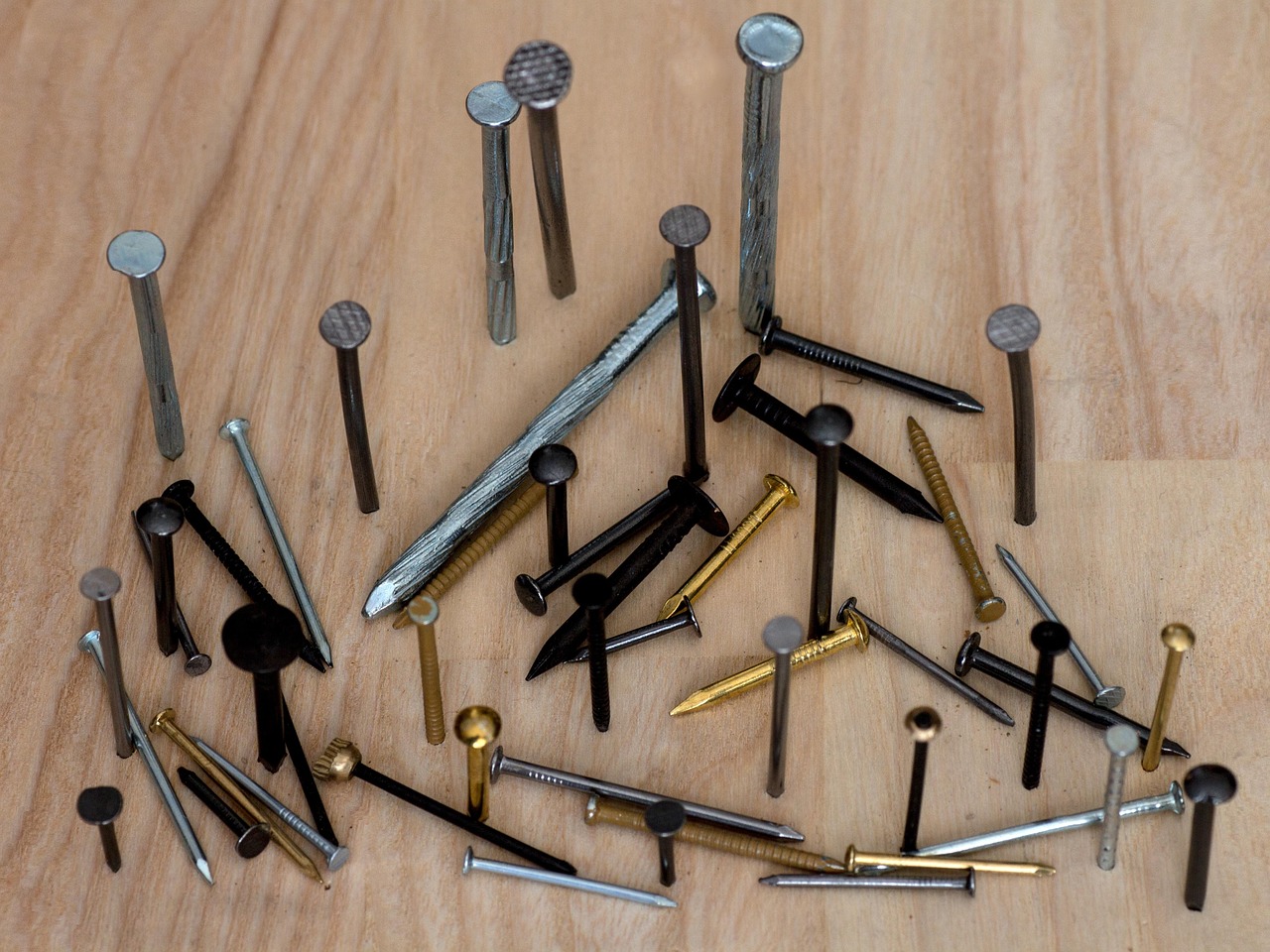
Hello everyone, this is DIY Renova.
When it comes to choosing nails for DIY, the correct answer actually depends on what you want to fix in what situation, rather than the thickness of the material. Moreover, nails are cheap, so even if you buy a random nail, the damage will seem small, and you'll be more likely to have to redo it later if it comes loose, cracks, rusts, or falls out.
This article focuses on ``how many mm and when to use nails'' that are often used in residential DIY projects, and includes various situations in ``practical selection.'' I will write this based on a Japanese wooden house, but I will also explain the ``way of thinking (rules)'' so that it can be understood by people overseas.
If you're wondering "How much renovation or remodeling can I actually do on my own home?" or "Where should I even start?", please visit this page. If you're looking to learn more about specific renovation processes or construction details, don't miss this page as well!
Information on updates to this website will be delivered to you once a month.NewsletterIf you are interested, please register.
Please note that this document is not necessarily accurate, and should be used as reference information only.
So, here you go.
First conclusion: If in doubt, start with “plate thickness x 2.5”
If you are unsure about the length of the nail, first use as a guideline ``at least 2.5 times the thickness of the board to be nailed''. This idea is also expressed in the wooden standard specifications for public buildings.
The reason why it is 2.5 times higher is because the holding power (difficulty in pulling out) of a nail strongly depends on how far it is stuck into the tree. If the penetration is shallow, even if it looks fixed, it will "float" due to the time difference.
If you use this ``2.5x rule'' as a starting point and then fine-tune it by ``susceptibility to breakage,'' ``humidity (rust),'' and ``work method (hand hammering/nailing machine),'' you will avoid clutter.
How to read nail markings: What are N65 and CN90?
"N nails" are often used in Japanese DIY. This is the symbol for "iron round nail" defined in JIS "JIS A 5508 (nail)", and the number is the length (mm). For example, "N65 = iron round nail with a length of 65 mm." In addition, the following types are organized (N, NZ, CN, CNZ, ZN, etc.).
- N: Iron round pole (indoor basics)
- NZ: Plated iron round nails (light rust prevention)
- CN: Thick iron round nail (thick = easy to break)
- CNZ: Plated thick iron round nail
- ZN: Hot-dip galvanized thick iron round nail (rust prevention for outdoor use)
The difference between "N/CN" is in the "thickness (diameter)" side. It's easy to first clear any doubts about the length (mm), and then move on to thickness and rust prevention if necessary.
``5 steps for choosing nails'' to avoid getting confused during work
Step 1: Verbalize what to fix
Example:
- I want to fasten plywood to pillars and studs.
- I want to fasten the board to the fuselage.
- I want to fasten construction materials (partitions, baseboards, etc.)
- I want to attach the subfloor plywood to the joists.
If this is not clear, you will be confused about the thickness and number of nails.
Step 2: Measure the board thickness and select the length by multiplying it by 2.5 times.
Example: 12mm board → 12×2.5=30mm or more → 32-38mm is a candidate
This rule itself is also clearly stated in the standard specifications.
Step 3: Adjust “thickness” and “distance from edge” depending on ease of breakage
If the ends break, the holding power will also decrease. The standard specifications indicate the idea of providing ``end clearances and edge clearances of 8 mm or more'' to prevent cracking.
When doing DIY, you can reduce mistakes by keeping in mind that ``the thinner the material, the further away from the edge it is, and the narrower the nails.''
Step 4: Increase rust prevention if it is humid or outdoors
The Ministry of Land, Infrastructure, Transport and Tourism's wooden standard specifications state that stainless steel should be used for outdoor or wet areas, and surface-treated steel should be used for other areas.
Even if you are doing DIY, it is safe to use anti-corrosion (CNZ/ZN/stainless steel) for outdoor areas, around water, and areas prone to condensation.
Step 5: If you are using a nail gun, make “penetration control” a top priority
Automatic nailing tends to cause the nails to sink in too much, resulting in a loss of fixation strength and a rough finish. Even in the standard specifications, there is a statement to prevent the nail head from sinking in too much.
In DIY, it is safe to adjust in the order of ``lower the pressure → test hit → bring it close to flush''.
How many mm is used for what? Housing DIY “on-site” size dictionary
Now on to the main topic. Summarize "when this size is used" in as specific a situation as possible. In addition, even if the length is the same, the type of nail (N/CN, plating, etc.) will result in different results even when used in the same way, so we will also discuss rust prevention and thickness in the second half.
19-22mm: Thin plates, temporary fixings, and easily breakable small items
Where to use (example)
- Temporary fixation of thin veneers, thin decorative boards, and curing materials
- Fastenings that you only want to position but may be removed later
- Scene of trial hammering on “thin material that is easy to break”
Why it's suitable for you
- Since the puncture is shallow, it is easy to remove and redo is effective.
- However, the holding power is not strong, so it is not suitable for "final fixation"
Common mistakes in the field
- This will hold the “floor” and “base plywood” in place, and it will flap later (not long enough)
25mm: “Basics” of 9mm plywood/thin board
Where to use (example)
- Fixing plywood of around 9mm to the base (light use)
- Scenes where a thin plate is layered on top of the base (surface side of the layered material)
Basis for selection
- 9mm x 2.5 = 22.5mm → 25mm is a length that is easy to follow the "2.5x rule".
Points to note
- If the substrate is hard (dry hardwood, old wood, etc.), it may bounce easily.
- For "final fixation" in areas subject to wind pressure and vibration, it is safe to run to a slightly longer side (32 to 38).
32mm: ``universal size'' for fastening thin boards (9 to 12mm class) to the wood base
32mm (example: N32) is a length that is often used when fixing "thin plywood/board materials" to the wood base in residential DIY. The dimensions are defined as 32 mm for JIS iron round nails (N nails), and the wire diameter and head diameter are also organized as standards (JIS A 5508).
Also, in the manufacturer's catalog, N nails are categorized as nails used for "general construction and packaging," and N32 is also included in the lineup.
When to use (example): Typical situations where 32mm is just right
The following are situations in which 32mm can be used comfortably in practical situations (all discussions are limited to "nails").
- I want to fix 9mm plywood to the wood base.
As a guideline, the official specifications state that the standard nail length is ``2.5 times or more the thickness of the board to be nailed.'' 9mm x 2.5 = 22.5mm, so 25mm is likely to be the smallest option, but 32mm is often chosen when you want to get a little more "stickiness" because you are afraid of floating, the base is thin, or the plywood is warped. - I want to fix 12mm plywood to the wood base, but I'm worried about the ease with which 38mm plywood will break.
Since the starting point is 12mm x 2.5 = 30mm or more, 32mm can be a logical "first candidate". It has less penetration compared to 38mm, but it is easier to handle in situations where the material is thin, the edges are close, or the aim is tough. - When fixing a “thin plate + light base” and using 25mm, the “effect” is weak.
For example, 32mm is useful when you are fastening a thin board to a support material such as a trunk edge or field edge, and you are worried about pulling it by hand if you use 25mm, or you want to suppress the warping. Again, the starting point is "plate thickness x 2.5 times or more". - When you want to avoid "lifting the finish" on the plywood base of the interior
If you don't want the surface to come apart after a few years by fixing the "base" by preparing the surface with plywood rather than the finishing material itself, 32 mm may be safer than 25 mm (of course, this is a trade-off with the ease with which the material breaks). - Wooden boxes/packing/simple woodworking work
N nails are categorized by manufacturers as being used for "general construction and packaging," and N32 is treated as one of their representative sizes.
In residential DIY, there are many situations in which "simple boxes, battens, and protective materials" are made for material management and on-site storage, and 32 mm is an easy-to-use length for that purpose.
Criteria for choosing 32mm: ``plate thickness x 2.5 times or more'' without deviation
If you are unsure, it is best to use the nail length as a starting point of 2.5 times the board thickness, and then adjust from there based on ``difficulty in breaking,'' ``penetration margin,'' and ``ease of targeting the base.'' This idea is also clearly stated in public standard specifications.
- 9mm board: 2.5x = 22.5mm → Starting from 25mm or more, go to 32mm depending on the situation
- 12mm board: 2.5x = 30mm → 32mm or more is the starting point (32mm is an easy candidate)
38mm: The royal road of 12mm plywood, most often used in DIY
Where to use (example)
- Fixing 12mm plywood (regardless of whether it is structural or ordinary plywood) to pillars or studs
- Fasten the board to the body edge (thin to medium thickness board)
- Places where there is a possibility that ``a little load will be applied later'' when fixing the plywood on the interior base
Basis for selection
- 12mm x 2.5 = 30mm or more → 38mm has plenty of room and can be moved in a direction that makes it difficult to float.
Points to note (cracks)
- It's easy to break if it's close to the edges, so make sure the edges and edges are wide enough (think 8mm or more).
- If you are hammering into thin construction materials, 38 may be too long to split, so judge based on the width of the material and the edge distance.
45mm: Place where the 15mm board/edge/base is solid
Where to use (example)
- Fixing a board material (thick plywood or board) of around 15mm to the base
- Places where the “receiving material” is solid, such as the trunk edge and field edge.
- "It's arrived at 38, but I want a little more bite" Scene
Decision points on site
- The longer the nail, the more vulnerable it is to "misalignment of the base" (if you miss the target, it will be a dry hit)
- If the base is not visible, "aim accuracy" is required for 45 or higher.
50mm: For fixing 18mm boards and other easily movable parts.
Where to use (example)
- Fixing the board material of about 18mm to the base
- The base is a little thin/I'm worried about the holding power because it's old wood → I want to make money by stabbing
- Situations where you want to increase the retention of one nail rather than increasing the number of nails (however, the risk of cracking increases)
Points to note
- Since it tends to increase in thickness, it tends to be unsuitable for materials that break easily (such as thin crosspieces).
- Features that are “visible” increase the damage caused by missed shots (holes stand out)
65mm: Frequently used for flooring and roofing, the “main size” for DIY
Where to use (example)
- Fixing the subfloor plywood (24mm class) to the joists and beams
- Fixing roof base materials (structural plywood, etc.) to rafters, etc. (as far as specifications allow)
- Thick plywood or “face material type” that requires strong fixing
Guidelines for official specifications
- The standard specifications for wooden construction state that ``CNZ65 nails should be used for flooring or roofing materials,'' and that CNZ50 is also acceptable for nails with a thickness of 12 mm or less.
This description is one of the reasons why 65mm is likely to be the main choice in DIY projects (however, your construction method and design specifications are the top priority).
Basis for selection (2.5x)
- 24mm x 2.5 = 60mm → 65mm is a natural candidate
Common mistakes
- The power of the nail gun causes the nail to sink in too much, which crushes the plywood surface and weakens the fastening.
- Remove the base and dry-paint (especially on the floor, it is difficult to notice later)
75mm: 30mm material class or situations where there are many overlapped materials
Where to use (example)
- I want to fasten a total of around 30mm of stacked material to the base.
- Situations where 65 feels insufficient for sticking, such as stacking and fixing 24mm plywood + thin board.
- I want to increase the stickiness because the base is soft (hard to get hold)
Points to note
- “Long nails” bend easily and are easily affected by aiming accuracy.
- The risk of cracking increases with thin materials and edges.
90mm: Thick material/base thickness is large, but you can choose where it comes in for DIY
Where to use (example)
- If the plate thickness exceeds 38 mm, the idea is to make it ``at least 2.5 times the plate thickness,'' and 90 mm class may appear for thick materials.
- So-called thick base material or fixing with large overlaps
But be careful
- In DIY situations where 90mm is produced, it tends to be "structural", so it is important to check design specifications, hardware specifications, and construction conditions.
- The type of nail (CN type, anti-corrosion) is also an area where it is easy to get entangled.
What are nails over 90mm used for? First, the overall picture.
90mm or more is usually required in one of the following cases.
- The "total thickness of the materials you want to fasten" is thick (many layers of material/thick hem and base material)
- I want to ensure sufficient "penetration" on the base side (I want to increase the holding power by sticking)
- 90mm class is assumed as the standard for 2×4 etc. (world of thick and long nails)
- The work is more like “building a frame” using a nail gun (framing)
However, long nails are ``easier to bend,'' ``drive blank if you miss the target,'' and ``easier to break,'' so the selection method will be more ``design-oriented.'' That's why you'll be able to decide comfortably if you know where to use it.
How to choose long nails is determined by the "2.5x rule + total thickness"
The previous concept of "plate thickness x 2.5 times or more" is also expressed in the wooden standard specifications. (mlit.go.jp)
For areas larger than 90 mm, you can reduce confusion by calculating backwards from the "total thickness of stacked materials" in addition to this.
- Total thickness (thickness of side material) = A
- Nail length = A x 2.5 as the starting point, or
- Decide on a penetration goal, such as "I want to penetrate at least 50 to 60mm into the base."
For example, if the exterior is made up of thick layers of "board material + rim + base material", it will quickly become 90mm class.
90mm: Fixed “first long length” with many overlapped materials
To put it simply, ``What do you use 90mm for?'' This is a situation where 75mm is not enough, but you don't want it to be heavier than 100mm.
Typical situations where 90mm is addictive
- "30mm plate" + "45mm rim" = total 75mm
If you want to ensure "penetration" here, a 75mm nail will hardly penetrate the base.
If you set it to 90mm, there will be 15mm more "margin" on the base (actually it depends on your aiming accuracy). - "24mm plywood" + "approximately 30mm layered material" = total 54mm
The starting point is 54mm x 2.5 = 135mm, but depending on the application, it may be decided on site to prioritize "penetration" and increase the number by 90 to 100 (this depends on the application and design).
Common mistakes that occur with 90mm and countermeasures
- Failure: “My aim was a little off and I fired blankly.”
Countermeasure: Be sure to visualize the base position (marking, detection, magnet) before hitting continuously. - Failure: “Cracks at the edges”
Countermeasures: Awareness of edge openings and edge openings (how to prevent cracking) (mlit.go.jp)
For thin materials, it is often better to use ``slightly shorter nails + more'' rather than ``trying to use one long, thick nail.''
100mm: “Standard long length” of thick material, effective for exterior base and layered materials
100mm is a "safety frame" when you want a little more margin than 90mm.
Typical situations for 100mm
- There are a lot of trimmings and overlapping materials in the exterior base, and we want to make a difference.
- I'm worried about the holding power of old or dried wood, so I want to increase the stickiness and prevent it from floating.
- The range of the nail gun is around 100mm, so you don't want to reduce work efficiency.
Things to keep in mind when using 100mm
- The longer it is, the easier it is to bend and the easier it is to run diagonally.
Therefore, if there is a possibility of hitting a hard substrate, knot, or hardware, it is always safe to test the first few shots. - It is more compatible as a “base material” than as a finishing material.
If you remove 100mm from the finished surface, it will be difficult to repair holes and chips.
115-120mm: Useful for thick layered materials or fixing “closer to the frame”
115mm and 120mm are often used in DIY work such as ``structural work'' and ``fixing thick materials together.''
Examples of situations where 115-120mm is suitable
- I want to stack and fasten “45mm square lumber class” + “plywood or board materials”
- Fasten thick pieces of wood together (however, for structurally important parts, design and hardware specifications are given priority)
The important point here is not that "long nails = stronger than anything." Depending on the part, the correct answer may be "structural screws," "bolts," or "dedicated hardware + designated nails" instead of nails. (However, in this article, we will focus on "selecting nails," so if you are in doubt, just make sure to follow the designated construction methods and hardware specifications.)
125-150mm: “Special use” for DIY, if you want to use it, meet the conditions
The 125mm and 150mm classes are almost never available in general interior DIY. What emerges is the area of ``fairly thick layered material'' or ``very close to the framework.''
Typical pattern with 125-150mm
- The layered material is thick and the top priority is to "stick it firmly to the base"
- Situations where it is necessary to “target” the nail using a combination of manual nailing and pilot drilling instead of using a nail gun.
- There is a clear reason why you want to use long nails (increasing the number of nails is not good, etc.)
Points to note in this area (super important)
- Long nails increase the risk of bending, deviating, and breaking.
- Edges and thin materials are particularly prone to cracking, so it is essential to be aware of edge and edge openings. (mlit.go.jp)
- “It looks like you hit it,” but in reality it doesn’t penetrate the base enough, which tends to happen.
Therefore, if you check the first 1 or 2 sticks on the back side or cross section so that they can be confirmed, the chances of failure will be reduced.
Choose the “type” of long nails as a set: N, CN, or rust-proof.
The longer the length, the greater the influence of "thickness (N/CN)" and "rust prevention (NZ/CNZ/ZN/stainless steel)". JIS organizes N/CN and plating types. (kikakurui.com)
How to choose a long piece on-site (very rough)
- Thin wood and fear of cracking: First of all, lean towards N (the number and position are better than dividing by thickness)
- Thick substrate/framework: Increasingly cases require CN (depending on construction method and specifications)
- Outdoors/humidity: Increase rust prevention
Even in the wooden standard specifications, the idea is to use stainless steel etc. outdoors or in humid conditions. (mlit.go.jp)
Practical way to align when buying 90mm or more (no mess)
Long items are often used only when needed, so if you buy them wisely, your inventory won't get cluttered.
- 90mm: Since there are many people who use it, it is convenient to have one small box.
- 100mm: “Standard” for people who use a lot of exterior base materials and layered materials
- 115mm or more: Buy after determining the need (it's easier not to keep it in stock)
Two axes are natural for affiliate leads: ``Small boxes by size'' and ``Outdoor use (hot-dip galvanized/stainless steel) of the same size.'' Readers are often confused about rust prevention after deciding on the length, so it would be helpful if you could include a search for outdoor products of the same length in the article.
By situation: "Example of size selection" determined in the shortest possible time
If you only use a "size dictionary", it would be troublesome to convert it in your head in practice, so I will summarize it in the form of scene → judgment → candidate.
Example 1: I want to fix 12mm plywood to posts and studs.
- Rule: 12 x 2.5 = 30mm or more
- Candidate: 32-38mm (38 if in doubt)
- Outdoor/humid: To the plating/molten zinc/stainless steel side (consideration of location conditions)
- Measures against cracking: Perforated edges/perforated edges (think 8mm or more)
Example 2: I want to fix the subfloor plywood (24mm class) to the joists
- Rule: 24×2.5=60mm or more
- Candidate: 65mm
- Reference: CNZ65 is indicated for nailing flooring and roofing materials.
- For a nail gun: Prioritize penetration control
Example 3: I want to fasten 9mm plywood for light purposes (preparing the base)
- Rule: 9×2.5=22.5mm or more
- Candidate: 25mm (32 if you are worried about floating)
- If “the board seems to be warping/moving”: Increase the number or length.
Example 4: I want to fasten thin parting materials and thin crosspieces (I'm afraid of cracking)
- Candidate: Start with 19-25mm, and go as far as necessary without cracking.
- Awareness of edge opening: 8mm or more to avoid cracking
- "Lengthening to increase holding power" tends to have the opposite effect on thin wood due to cracking.
Example 5: I want to keep outdoor wood in place (rain, condensation, humidity)
- Nail material: The idea is to use stainless steel for outdoors or in wet conditions, and surface-treated iron for other cases.
- Practical: Change to “plating/hot-dip zinc/stainless steel” even if the length is the same
- How to buy: If you have outdoor items, you can get them in small boxes by size to reduce the hassle of buying more items.
Results vary depending on the type of nail: N/CN, anti-corrosion (NZ/CNZ/ZN), stainless steel
N and CN: The thicker it is, the stronger it is, but the easier it is to break.
JIS distinguishes between "iron round barges (N)" and "thick iron round bars (CN)."
Thick nails can generally be advantageous for holding and shearing, but in DIY applications, the more cracks and misses that occur, the weaker the nail will be overall. So it's safe to think like this:
- There are many features, thin materials, and edges: First, it is closer to N.
- There is a specification for thick plywood, flooring, etc./Thickness is assumed: Close to CN (designated first priority)
- When in doubt: Correct the length and create quality with the number and edge distance
Rust prevention: When outdoors, changing the type of nail is the top priority
JIS organizes plating (NZ, CNZ) and hot-dip galvanizing (ZN).
Furthermore, the wooden standard specifications state that stainless steel should be used for outdoor or wet areas.
Even with DIY, it is often the most cost-effective option to upgrade the rust prevention grade for outdoor, condensation, and water areas (it is more expensive to redo the product due to rust).
Here's some engineering stuff: Holding power is determined by "wood density x diameter x penetration depth"
Just a little more convincing "Why 2.5 times?"
It is common in North American technical documents to explain that the strength of retention (pulling) and shearing of wood depends on the specific gravity (density) of the wood, its diameter, and the depth of penetration of screws and nails.
Additionally, the American Wood Council has released the Connection Calculator, a connection calculation tool based on NDS (Wood Design Standards) that supports strength calculations for nails, bolts, etc.
What we can see from this is that ``the performance of nails is determined by their size and penetration throughout the world,'' so it is reasonable to choose ``reasonable length'' instead of ``somehow long nails'' even in DIY projects.
Final check of practical work: These three things will drastically reduce “redo”
- "Length" should not be removed from board thickness x 2.5 times or more.
- No cracking (edge clearance/edge clearance of 8mm or more)
- Outdoors/humidity improves rust prevention (concept of stainless steel, etc.)
If you keep these three things in mind, your DIY nail selection will be quite stable.
If you're wondering "How much renovation or remodeling can I actually do on my own home?" or "Where should I even start?", please visit this page. If you're looking to learn more about specific renovation processes or construction details, don't miss this page as well!
Information on updates to this website will be delivered to you once a month.NewsletterIf you are interested, please register.
Please note that this document is not necessarily accurate, and should be used as reference information only.
How to buy nails (“minimum set” that doesn’t clutter your inventory)
We propose a minimum set with the aim of "not getting lost on site." It's easy to naturally insert affiliate links here, so you can replace the product link with your standard when publishing the article.
Indoor main minimum set
- 25mm (9mm plywood/thin board)
- 38mm (the mainstay of 12mm plywood)
- 65mm (mainstay for floors and thick plywood)
Add if you want to touch outdoors too.
- Above three sizes of “plated/hot-dip galvanized/stainless steel” versions (select based on usage and cost)
Search keyword example (can be used as is for product search)
- "N38 iron round nail"
- "CNZ65 connecting nail"
- "Stainless Steel Nail 38mm"
Amazon and Yahoo Shopping make it easy to find items by size, so readers don't have to worry about shopping.
References (APA 7th edition)
American Wood Council. (n.d.). Connection Calculator. Retrieved February 1, 2026, from https://awc.org/calculators/connection-calculator/

American Wood Council. (2025, April 18). AWC releases updates to Connection Calculator. Retrieved February 1, 2026, from https://awc.org/awc-releases-updates-to-connection-calculator/

Cold-Formed Steel Engineers Institute. (n.d.). TECHNICAL NOTE: Wood screw strength (withdrawal & shear dependence on wood specific gravity, diameter, penetration depth). Retrieved February 1, 2026, from https://www.cfsei.org/assets/docs/technotes/TechNote-F101-24Sec.pdf

Ministry of Land, Infrastructure, Transport and Tourism. (2025). Public building wooden construction standard specifications (2020 edition). Retrieved February 1, 2026, from https://www.mlit.go.jp/gobuild/content/001888858.pdf

Japanese Industrial Standards. (2009). JIS A 5508:2009 Nail. Retrieved February 1, 2026, from https://kikakurui.com/a5/A5508-2009-01.html
 English
  Japanese
Leave a Reply
You must be logged in to post a comment.